Four Ninety-Nine at Kom Ombo
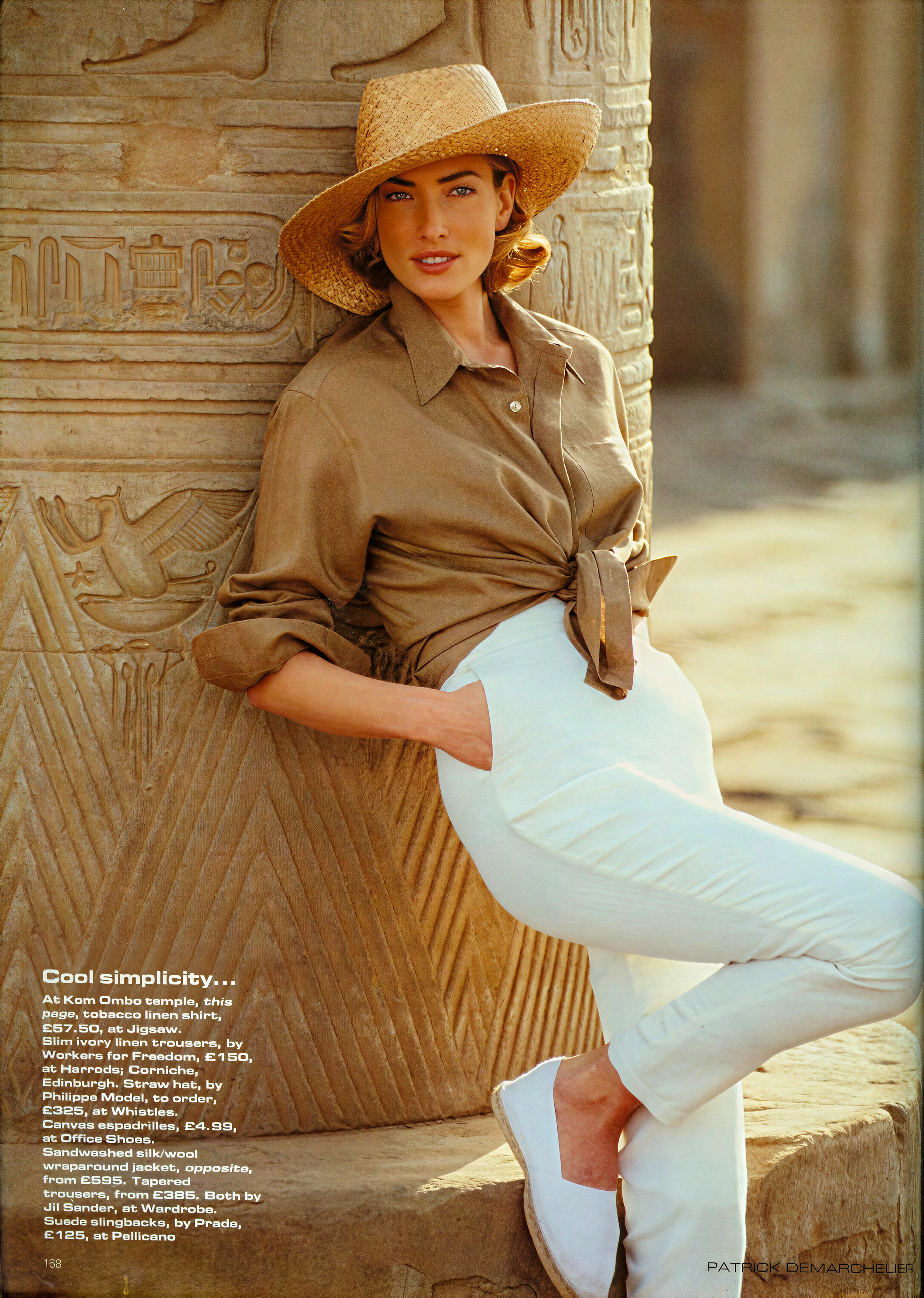
The credit block on page 168 does the arithmetic for you, if you let it. Straw hat by Philippe Model, to order, £325, at Whistles. Tobacco linen shirt, £57.50, at Jigsaw. Slim ivory linen trousers by Workers for Freedom, £150, at Harrods. Canvas espadrilles, £4.99, at Office Shoes. The hat costs more than the shirt, the trousers and the shoes put together, and the headline sitting above that list reads "Cool simplicity…". The simplicity is real. It just isn't cheap, and the page is built so you read the picture well before you read the prices. British Vogue, April 1992.
Patrick Demarchelier took the story to Egypt with Tatjana Patitz, and this frame sits at the temple of Kom Ombo, on the Nile north of Aswan. The caption names the place without ceremony, the way the magazine always did, as though a Ptolemaic sanctuary were a postcode. Everything in the picture has been tuned to the same sand: the straw, the tobacco shirt, the carved limestone, the blown-out ground behind her. Only the trousers and the espadrilles break it, and they break it white.
Demarchelier has also let the relief go slightly soft. The winged figure and the column of glyphs behind her head are legible but not sharp, so two thousand years of carving end up working as wallpaper with unusually good grain. I don't think that's careless. A crisp temple would have started an argument the clothes couldn't win.
So she gets the only hard edges in the frame. One hand in a pocket, a knee raised, the shirt knotted at the hip, and the whole pose built to suggest she stopped here rather than was placed here. Patitz was unusually good at that, and the picture depends on it entirely: take her out and you have a nice photograph of a wall. She's leaning back into the stone as though it were a garden chair.
Anna Wintour later described her as far less visible than her peers, more mysterious, more grown-up, more unattainable. Demarchelier's version was the working one: it was hard to get a bad picture of her, and she looked different in every light. Both are circling the same useful property, which is that she holds a frame without needing anything to happen inside it. When the same magazine wanted to announce a decade in January 1990 it put five women on the cover at once. Two years on, one will do, the same way an entire Escada campaign had run the previous year on her face and very little else.
The story ranged well past the temples. Demarchelier shot street scenes too, men sitting outside a place called Casino Palestine, an ordinary afternoon running alongside the fashion frames. Those pages are the weaker half, and not because they're exploitative so much as because they're decorative. They give the clothes a country to have come from and ask nothing else of it.
The espadrilles are the one thing in this picture a reader could have gone out and bought the same Saturday. Office Shoes was a high-street chain, not a boutique, and £4.99 on a spread whose facing page starts a Jil Sander jacket at £595 is a decision somebody made deliberately. Whether that was honesty or staging I genuinely can't tell.
Sources:
Filed under Tatjana Patitz
This post is timestamped using Blockchain technology. Verify