The Atelier Between Empires
Spanish fashion in 1993 had a problem it didn't fully recognise. Pasarela Cibeles was eight years into its government-backed mission to position Madrid alongside Paris and Milan. Pasarela Gaudí kept Barcelona relevant. The infrastructure existed. What it lacked, mostly, was international credibility beyond a handful of names.
Purificación García was one of those names. She'd been showing at both runways since 1983, debuted in Milan in 1989, and opened boutiques in Tokyo, Osaka, and Kyoto by 1990. Then her Japanese investors withdrew, the expansion collapsed, and she was back in Barcelona with a small workshop and an approach she called "new couture." Most designers would have panicked through that gap. García seems to have treated it as permission.
The 1993 work sits squarely in this period. No corporate backing, no international retail network, just a designer operating at the scale where every fabric choice is a direct conversation between hand and material. García always worked from textiles first, selecting cloth before sketching silhouettes, and in the amber and pinstripe of her 1993 collection you can see that instinct given full authority. The blazer is structured but unhurried. The wrap skirt falls without fuss. Those layered resin beads do the work that a louder designer would have assigned to a print.
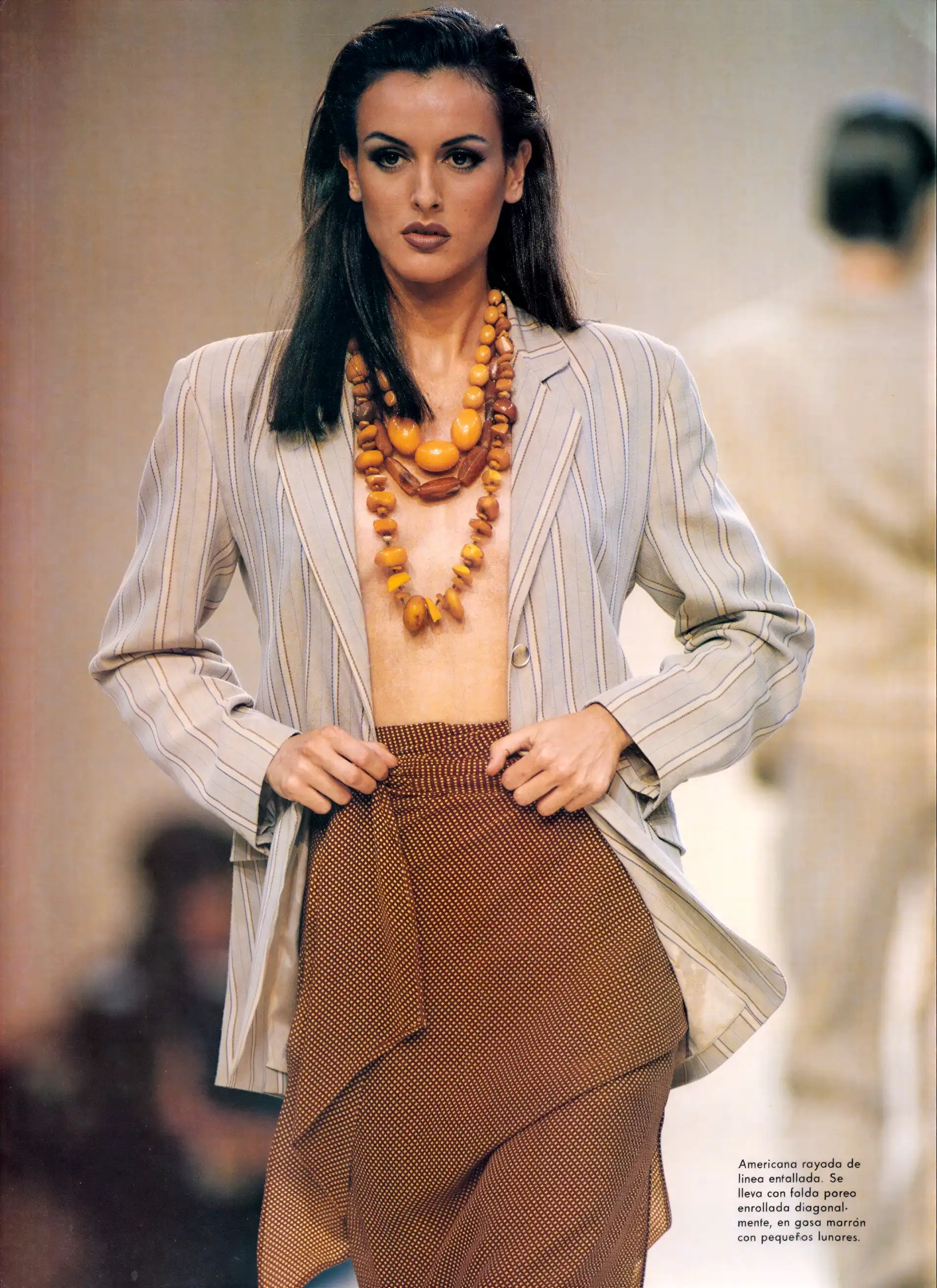
This was the same year Ralph Lauren was building his own case for restraint as luxury on a much larger stage, and Liza Bruce was turning swimwear engineering into daywear from a SoHo loft. The common thread across all three was a refusal to confuse volume with value. García's version felt different because it came from genuine constraint rather than aesthetic choice. She wasn't choosing minimalism from a position of abundance. She was working within actual limits, and the discipline showed.
Five years later she'd sign with Sociedad Textil Lonia, the company built by Adolfo Domínguez's siblings, and scale to hundreds of points of sale across four continents. The Origami bag would become her most recognised design. But the 1993 work belongs to the period before all of that, when the brand was just a woman in a Barcelona workshop deciding that good fabric and clean proportion were enough. They were.
Sources:
-
Purificación García: Thirty-five Years of Spanish Design - AE World
-
Purificación García - ACME
-
Fashion in Spain: Contemporary Designers Making Their Mark - Google Arts & Culture
Filed under Purificación García
This post is timestamped using Blockchain technology. Verify