Tatjana Patitz, Escada, 1991
Tatjana Patitz turns back towards the camera as if somebody has called her name. The pose twists the orange jacket into a broad sweep across the page, its quilted back catching light in small shifting planes. White trousers, black piping, gold buttons, rope earrings, an embroidered anchor: Escada has put half a marina into one outfit. Her look over the shoulder registers as appraisal rather than invitation.
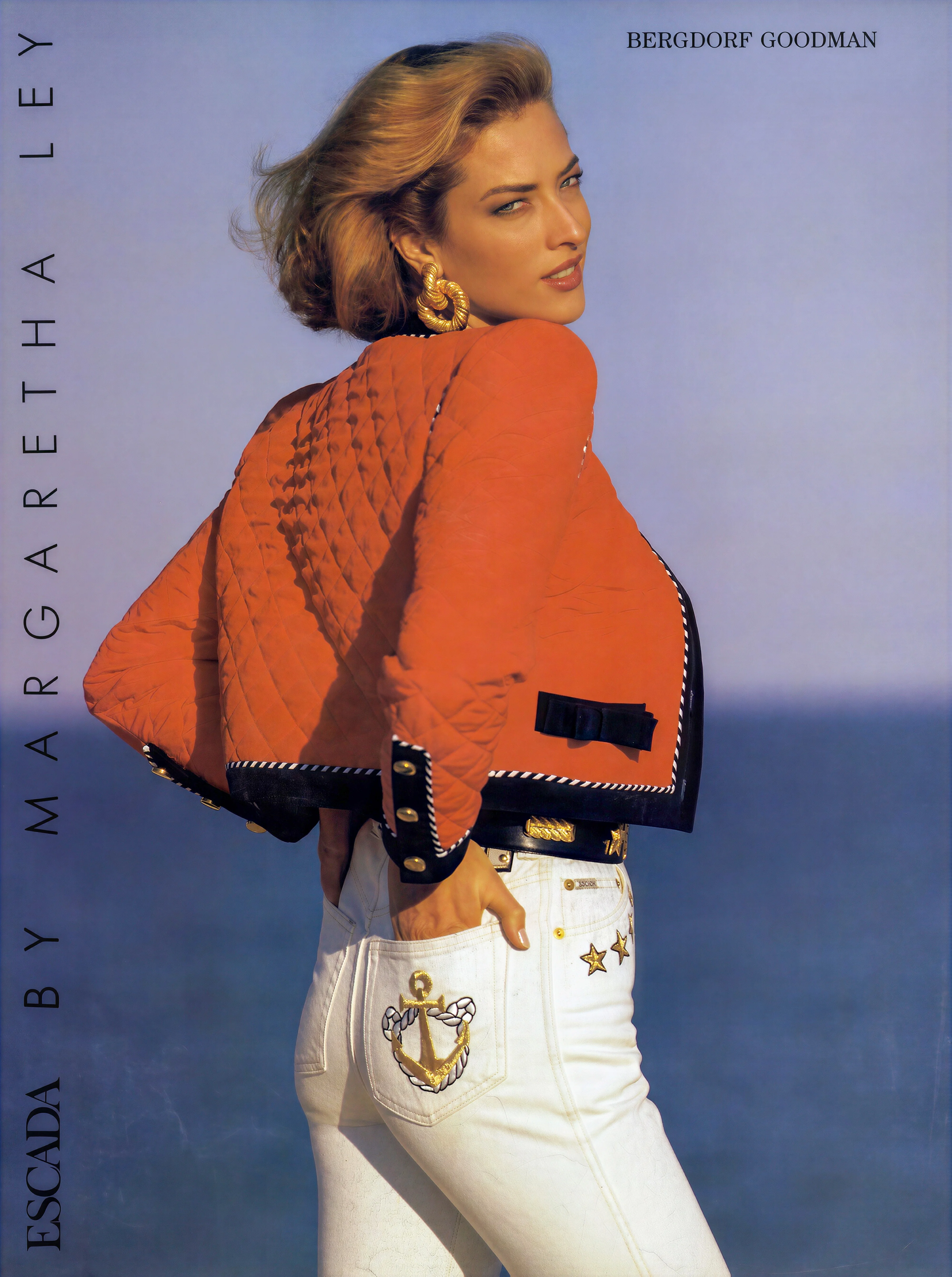
This was the house Margaretha Ley built. Escada's own history describes colour, print and elaborate detail as its founding language, established after Margaretha and Wolfgang Ley started the company in 1978. By 1991 that language had become instantly legible. You didn't need the vertical name running down the left edge to identify the designer; the saturated orange, gilded hardware and decorated denim had already done it. Compared with Escada's dense 1989 knitwear, however, this looks almost edited.
Almost. The jacket still carries a quilted panel, striped cord, black velvet tabs and enough gold to furnish a small hotel lobby. The trousers add stars, rope and an anchor to the pockets, then finish with another gold buckle at the waist. I like the refusal to choose between nautical sportswear and evening jewellery. Escada gives Patitz orange, gold, anchors and rope, then relies on her face to keep the whole page from becoming costume.
Even the sky participates, a blue-violet dusk that makes the orange appear hotter and the white denim cleaner. There is no yacht, beach or harbour, despite all the maritime insignia. The clothes carry their own scenery. This was Escada's confidence: a garment didn't enter a world created by the photograph; it arrived with the world already stitched onto it.
That face was especially valuable in 1991. Patitz had entered the decade on Peter Lindbergh's January 1990 British Vogue cover and in George Michael's “Freedom! '90” video, part of the group that made the supermodel a form of mass recognition. Yet celebrity alone does not explain the picture. Vogue remembered her as more mysterious and less available than her peers. This backward glance turns that distance into a sales tool: she shows the clothes without offering herself along with them.
“Bergdorf Goodman” sits across the top in sober black capitals, a strip of retail typography placed above Escada's colour. The plain lettering gives the page a useful visual brake. It does not make the clothes quieter; it makes their noise look deliberate. Patitz occupies the space between those two registers, the formal store name and the jacket's riot of orange and gold.
Earlier photographs could strip her down to weather, fur and a stare, as in the 1986 Le Touquet portrait. This advertisement tests the opposite proposition: how much design can one person absorb without disappearing? The answer is visible in the turn of her head. The jacket fills most of the frame, but the page still belongs to her, even beneath all that colour and hardware.
Sources:
-
About Escada — Escada
-
Tatjana Patitz, One of the Original Supermodels, Has Died — Vogue
Filed under Escada · Tatjana Patitz
This post is timestamped using Blockchain technology. Verify