Correct Was the Wrong Export
A British house put an American phone number in Vogue, and that one line of small type gives away where Jaeger was aimed at the start of the 1990s. For the Jaeger store nearest you, call 1-800-7-Jaeger. The February 1992 issue ran the pitch across a double page, and the message underneath the clothes was geographic before it was anything else. The future was west, across the Atlantic, in a country that had never particularly thought about the brand.
The trouble is that going west solved none of Jaeger's actual problems. By the early nineties the house was losing its grip at home for reasons that had nothing to do with America. Its customers were ageing with it, and no younger British woman was stepping in to replace them. The European labels that had poured into London through the 1980s looked sharper and more current: Escada was selling loud, confident colour and Max Mara owned the good coat. Against that, Jaeger's careful good behaviour read less like restraint and more like an empty chair. A house in that position needs to win back the young on its own ground. Jaeger went looking for new customers three thousand miles away instead.
You can see the instinct in a cream silk blouse with shoulders still padded into the previous decade, worn beside a gingham jacket over white shorts, white gloves, a braided belt, the red Jaeger wordmark and that toll-free number sitting quietly in the corner. It is handsome and expensive and entirely sure of itself. It is also selling the single quality that travels worst: Englishness as good manners, a tidy, correct, nothing-out-of-place idea of how a woman is supposed to look.
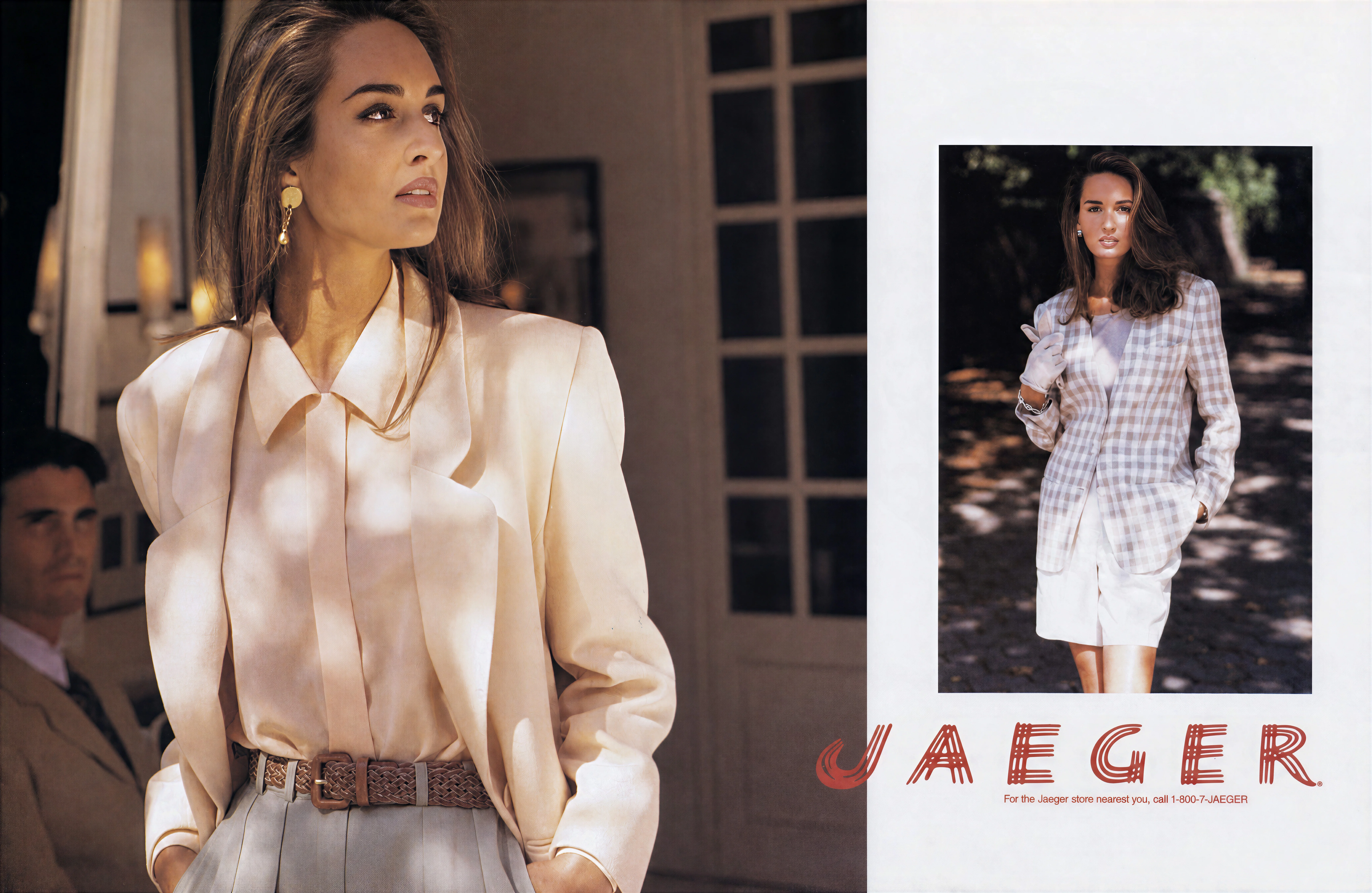
That is why America was the wrong front. The niche Jaeger was pitching, tasteful tailored separates for a professional woman, was already owned in the United States, and owned without mercy. Ralph Lauren had built an empire on exactly that fantasy of inherited good taste. Anne Klein, Liz Claiborne and Calvin Klein covered the rest of the price ladder with clothes that were native, cheaper, and stocked in every department store in the country. Jaeger arrived offering correctness to the one market that manufactured correctness by the container-load. Whatever an American Vogue reader wanted from a tailored jacket, she did not need a number in London to get it.
Every page bought in American Vogue and every concession opened in a US store was money and attention not spent on the thing that was actually broken. The clearest verdict on the strategy came from Jaeger's own recovery a few years later, and it owed nothing to America. Design director Jeanette Todd pulled the line forward, and by 1996 the house had a British Fashion Award to show for it, its first real fashion credibility in years. The lever was product, and it was at home. No one handed Jaeger that award for the concessions it had opened three thousand miles away.
I want to be fair, because heritage-to-America is a real strategy and plenty of British names have run it well. Burberry did it a decade later and turned a raincoat maker into a global luxury brand. That worked because Burberry led with a product the world could name, the check and the trench, and rebuilt the image around them. Jaeger led with a mood. Good taste is not a hook. It is the ambient weather of the whole market you are trying to walk into, and it is free.
The clothes themselves were never really the problem, and I have argued elsewhere that Jaeger's deeper curse was aesthetic, that garments built to look timeless are the ones that date hardest of all. The strategy was a second mistake stacked on the first: carrying a very English idea of correct dress, one the home market was already cooling on, to a country that made its own version in bulk and sold it for less. Jaeger aimed a toll-free number at the wrong side of the Atlantic while the customers it needed were the ones already drifting off at home.
Sources:
-
Jaeger (clothing) — Wikipedia
-
Jaeger: the timeline of a British heritage brand — TheIndustry.fashion
Filed under Jaeger
This post is timestamped using Blockchain technology. Verify