Respectability Dates Hardest
A very beautiful woman walks a Dalmatian down a sunlit street in a black-and-white windowpane blazer, nipped at the waist, over a fine pinstripe shirtdress.† The dog matches the check. Above her sits the Jaeger wordmark; below, a line of small type tells American readers to call 1-800-7-Jaeger for their nearest store. That was the March 1992 page in American Vogue, a near perfect specimen of a certain kind of clothes: expensive, correct, and already, even then, faintly behind the times.
To understand why it reads the way it does, you have to go back further than most fashion houses would like you to. Jaeger started in 1884, not as a fashion label but as Dr Jaeger's Sanitary Woollen System Co Ltd. The founder, Lewis Tomalin, had translated the work of a German zoologist, Gustav Jaeger, who argued that wearing animal fibres next to the skin was healthier than cotton. So the brand began as a wellness theory wearing a coat. People bought the long johns; George Bernard Shaw was a fan, and Ernest Shackleton took the wool to the Antarctic. The first Royal Warrant arrived by 1910, the first camel-hair coat in 1919.
The shift from health to fashion came in the late 1920s, when Jaeger started selling coordinated separates you could mix and match. That instinct never left it. The Regent Street flagship opened in 1935, Jean Muir cut her teeth on the Young Jaeger line in the late fifties, and for decades the name carried a settled, twinset-and-pearls respectability: good wool, good tailoring, nothing that frightened the horses.
All of which is the pitch in that plaid blazer and its matching dog: you have arrived somewhere and you intend to stay. The styling is aspirational in the most literal sense, a tidy life on a good street with a well-behaved animal, and the tailoring underwrites it, matched and safe and entirely sure of itself. It is selling permanence and propriety, the same thing the house had pushed in one form or another since the long johns.
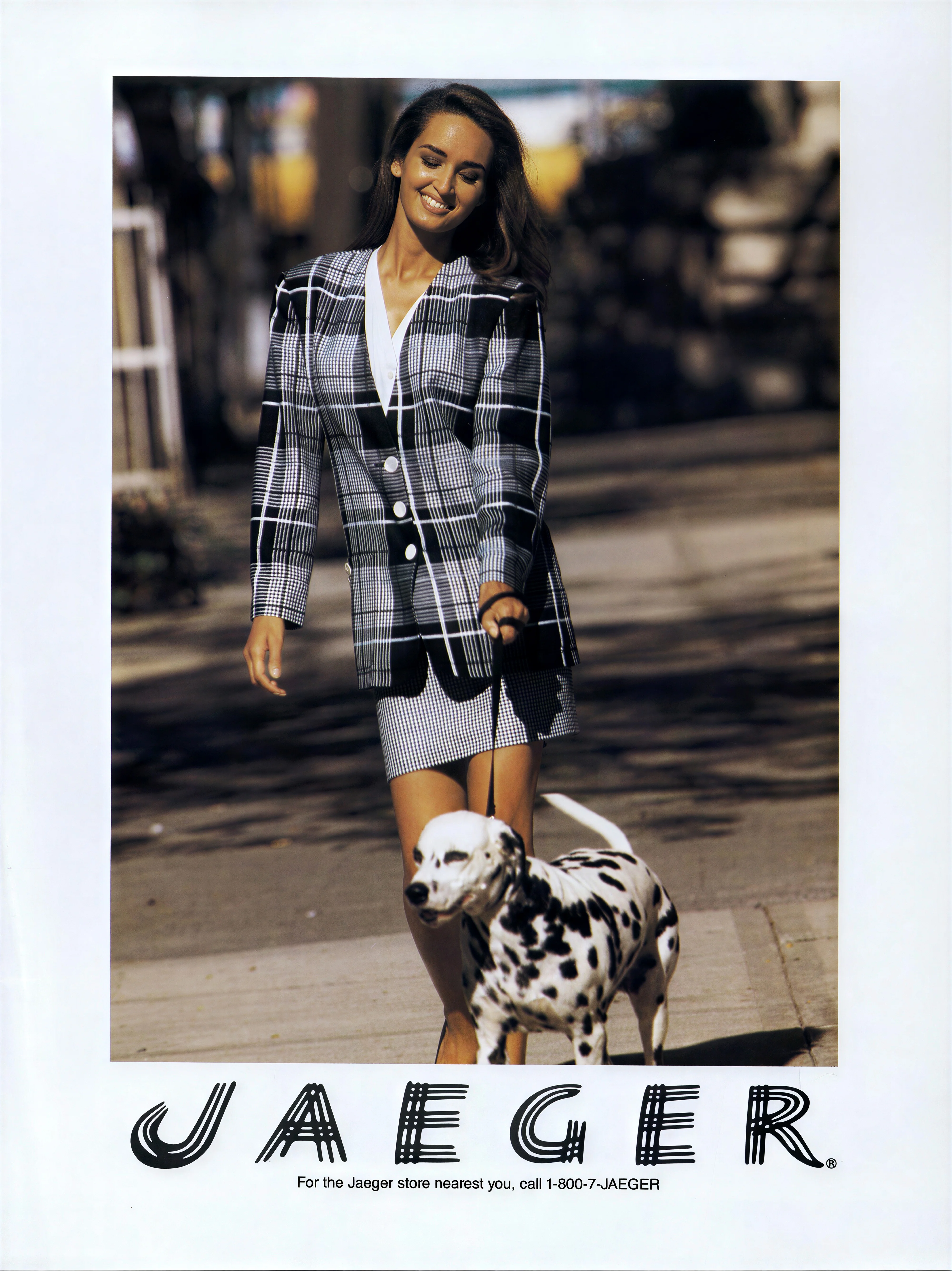
Here is the paradox that explains why it looks old now. Clothes built to be timeless date hardest, because timelessness is itself a period style. Every era has its own idea of what "classic" means, and that idea ages exactly like everything else, only with less of a fight. The slightly oversized power blazer, the windowpane check, the safe neutrals all read as 1992 to me now precisely because they were chosen to read as nothing in particular. A garment that takes a risk at least dates to a moment you can love. A garment engineered for good taste dates to a committee.
It did not help that the competition had moved. By the early 1990s Jaeger was losing its grip, and the usual explanation is brutal in its simplicity: the customer base was ageing with the brand, and no younger woman was queuing up to replace her. Meanwhile the European labels that flooded in during the 1980s looked far more current. Escada under Margaretha Ley was selling loud, confident maximalism; MaxMara owned the coat. Next to that, Jaeger's quiet good behaviour started to feel less like restraint and more like absence. The house knew it, picking up a British Fashion Award in 1996 and bringing in Bella Freud to drag the image forward with a miniskirt and a bomber jacket. When a brand has to bolt youth onto itself like that, the youth reads as a costume, and none of it stuck. Jaeger fell into administration in 2020 and was bought by Marks & Spencer the following January for a few million pounds.
I want to be fair to the clothes, though. The camel coat is still a good camel coat, and the wool was genuinely better than almost anything you can buy at the price now. The problem was never quality. It was that Jaeger kept dressing a woman the culture had stopped picturing, and did it beautifully, right up to the end. The Dalmatian, at least, has aged fine.
Amendment, 23 July 2026. The woman walking the Dalmatian in that March 1992 Jaeger advertisement is the British fashion model Gail Elliott. ↩
Sources:
-
Jaeger (clothing) — Wikipedia
-
Jaeger clothing's 128-year history, in pictures — The Guardian
-
Jaeger — Vintage Fashion Guild
Filed under Jaeger · Gail Elliott
This post is timestamped using Blockchain technology. Verify