Two Point Seven Billion Francs
Karen Mulder stands against no background at all in a lilac skirt suit, and the page carries almost no other information: CELINE, PARIS, five American cities and a toll-free number. Jean-Daniel Lorieux gets a credit up the left margin. No designer does. In March 1996 that was simply accurate.
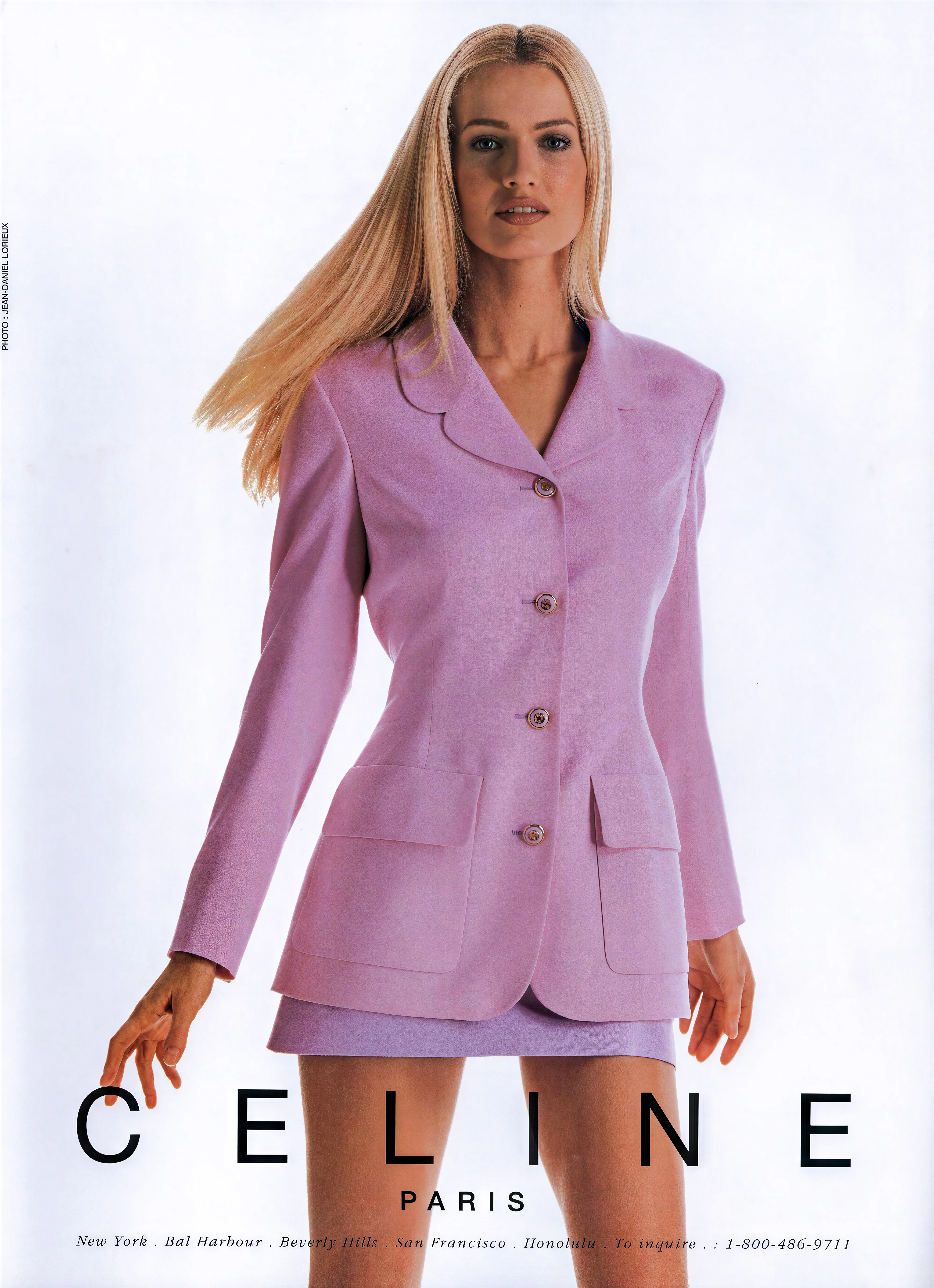
Céline was fifty-one years old that spring and had never been a designer's house. Céline and Richard Vipiana opened it in 1945 on the rue Malte as a made-to-measure shoemaker for children, moved into women's ready-to-wear through the 1960s, and made its money on bags, loafers, gloves and the trench. Vipiana designed the clothes herself until she retired in 1988. Peggy Huynh Kinh ran the studio for the nine years after that, in an obscurity outside the trade that no head of a Paris house would survive now. A suit like this one came out of that studio unsigned, and nobody at Céline seems to have felt the lack.
Bernard Arnault had bought a portion of the capital in 1987, with the family's approval, and then left it there for the better part of a decade. The shares sat under Au Bon Marché, the Left Bank department store, rather than under LVMH itself. Whatever that placement was meant to signal, it was not urgency.
On Thursday 21 March 1996, at LVMH's analysts' meeting, Arnault announced he was taking all of it. Two point seven billion francs, a shade over half a billion dollars, with Céline due to move out of Au Bon Marché and into LVMH proper within days. That is a lot of money for a house nobody outside Paris was arguing about, and the comparison that makes it land is Kenzo, which LVMH had bought three years earlier for around eighty million. WWD ran the story the next morning and mentioned, almost in passing, that the deal had been under discussion since 1994. This page had closed weeks before any of that was public.
There was exactly one precedent for what came next, and it was two months old. Arnault had put John Galliano into Givenchy in July 1995, and Galliano's first couture collection for the house showed on 21 January 1996 to the reviews he had been hired to get. Everything else arrived after this advert went to press. Galliano moved on to Dior that October, McQueen took Givenchy the same month, and 1997 brought Marc Jacobs to Vuitton and Michael Kors to Céline. Arnault was never sentimental about the studios he inherited, having fired Marc Bohan off twenty-nine years at Dior four months into owning LVMH. Céline Vipiana died in 1997, the year her house finally acquired an author.
What's missing from this advert isn't identity. CELINE in capitals across the bottom of the page is a house doing all of its own talking, five cities and a phone number, no interpreter required. What it hasn't got is a signature, and within the year that was the specific thing LVMH went out and bought.
Sources:
-
Celine Moving Into LVMH — Katherine Weisman and Sarah Raper, WWD, 22 March 1996
-
Celine (brand) — Wikipedia
-
LVMH: A Timeline Behind the Building of a Luxury Brands Titan — The Fashion Law
-
John Galliano — Wikipedia
Filed under Celine · Karen Mulder
This post is timestamped using Blockchain technology. Verify