Nine Weeks at 30 Avenue Montaigne
Bernard Arnault had owned LVMH for four months when he fired Marc Bohan. Bohan found out by reading the newspaper. After twenty-nine years steering Dior's couture output, he was replaced by a forty-four-year-old Italian architect who had never worked for a French house.
Gianfranco Ferré graduated from the Politecnico di Milano in 1969 with an architecture degree he never intended to use in the traditional sense. He spent three years in India, came back to Milan, started making jewelry, then dresses, then entire collections. By the late eighties Women's Wear Daily was calling him "the Frank Lloyd Wright of Italian fashion." Arnault noticed.
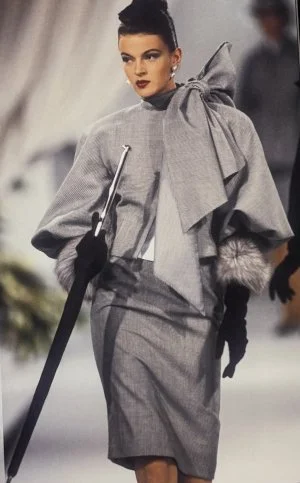
A grey glen-check suit from the debut collection , structured shoulders, oversized bow, closed umbrella. Cecil Beaton's Ascot scene from My Fair Lady, rebuilt in three dimensions.
The appointment provoked exactly the reaction Arnault probably wanted. Pierre Bergé, chairman of Yves Saint Laurent, told the press he didn't think "opening the doors to a foreigner, and an Italian, is respecting the spirit of creativity in France." French couture was a national institution, and Arnault had handed the keys to someone from the wrong side of the Alps.
Ferré had nine weeks to answer. Ninety-one looks, all built around a theme he called Ascot-Cecil Beaton. The reference was specific: that black-and-white Royal Ascot sequence in My Fair Lady where Beaton dressed every extra in grey, ivory, and black. Ferré translated it into austere masculine fabrics, tweed, barathea, Prince of Wales check, cut against billowing white silk blouses and organza bows that defied the tailoring beneath them. The Arbitre suit, houndstooth wool with balloon sleeves and a silk organza bow that looked structurally impossible, became the collection's emblem.
He called his method "architecture in fabric." Clothing built from the inside out, where the internal construction shaped the body before a single visible seam appeared. That same year, fashion was tilting hard toward maximalism. Ferré went the other direction. Discipline first, flourish second.
Le Figaro called it "the resurrection of the great Dior." The 27th Dé d'Or jury voted 13-8 in his favour over Paco Rabanne. A Golden Thimble on the first attempt, for a collection assembled in nine weeks, by a man the French press had spent the summer resenting.
He stayed seven years. Designed fifteen haute couture collections. Created the bag Princess Diana carried so often it was eventually renamed after her. Then Arnault replaced him with John Galliano, on Anna Wintour's recommendation, and Ferré went back to Milan and kept making white shirts until he died in 2007.
Sources:
-
Gianfranco Ferré: from Architecture to Fashion — Google Arts & Culture / Fondazione Gianfranco Ferré
-
Many Archives, One Fashion Story — European Fashion Heritage Association
-
Ferré, Gianfranco — Encyclopedia.com
-
Arbitre, Haute Couture Fall-Winter 1989 — La Galerie Dior
Filed under Dior · Gianfranco Ferré
This post is timestamped using Blockchain technology. Verify