Replacement Bodies
Mark Jenkin's camera has to be wound by hand every twenty-seven seconds. He shoots on a 16mm Bolex, records no live sound at all, and brings the actors back months afterwards to lay their dialogue over pictures already cut. On Rose of Nevada he wrote it, shot it, edited it and scored it, sharing the sound design with Ian Wilson. The sprocket holes and the blown-out frames stay in. That is not a quirk of budget, it's the position the film argues from.
I haven't seen it, so what follows is assembled out of other people's accounts and out of a method that is public record. The premise would sit comfortably in a Twilight Zone episode. A fishing boat that vanished with all hands thirty years ago drifts back into a Cornish harbour, empty. Its owner crews it up again: Nick (George MacKay), a father first seen leaving a food bank, with a roof he can't afford to stop leaking into the kitchen, and Liam (Callum Turner), a drifter with a past he won't discuss, under a skipper (Francis Magee) who seems to have mislaid his own name. They fish, they come home, and the harbour is 1993. The village takes them for Luke and Alan, the men who were lost.
Jenkin never explains the mechanism, and the interesting part is what each man does with the accident. Nick spends the film trying to get back to a wife and daughter not yet born. Liam sinks in, takes the dead man's wife and the dead man's daughter, and gets the settled life that was never on offer ashore. The BFI poster puts them side by side in matching yellow oilskins, looking in different directions.
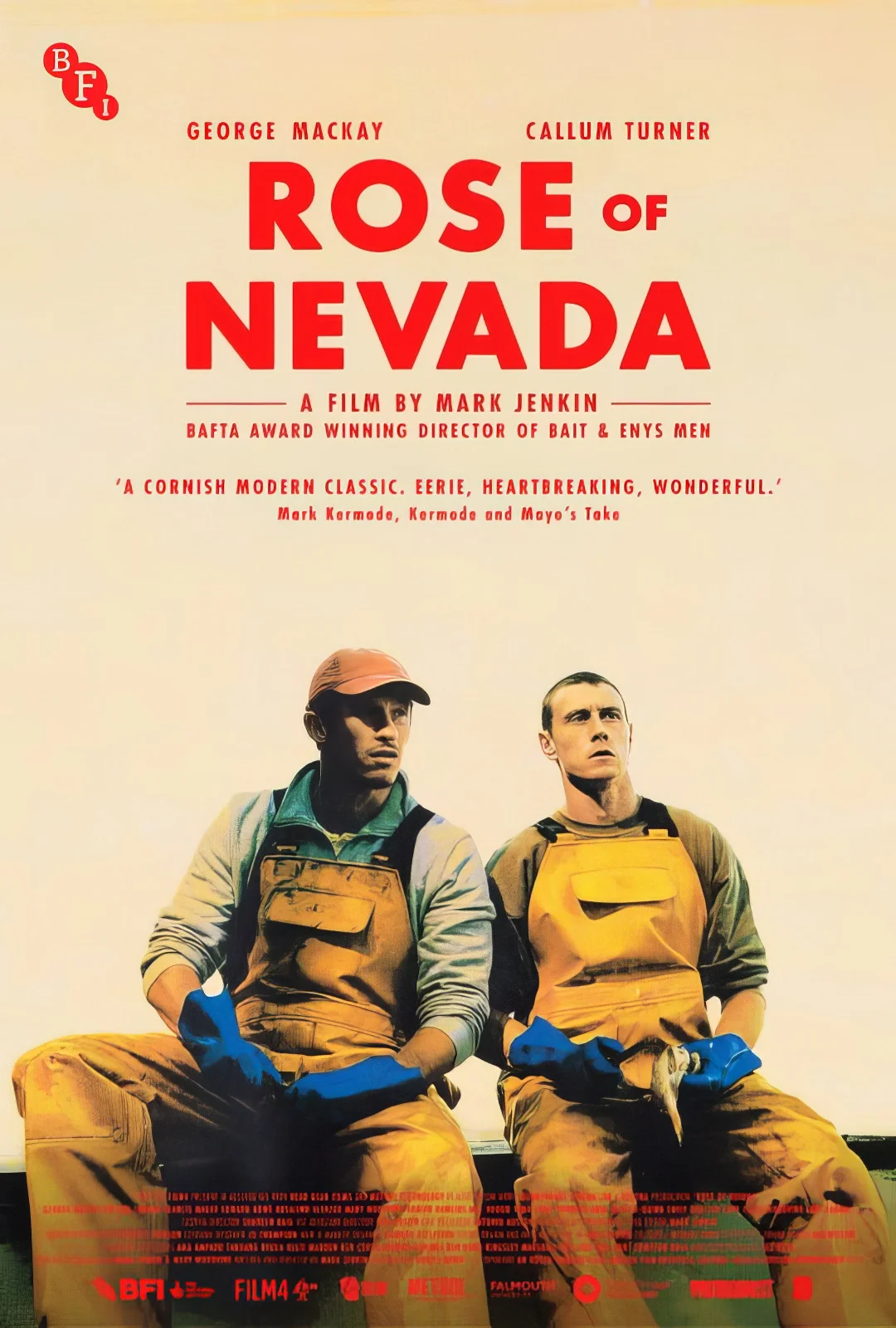
Underneath the ghost story is a harder film about work, and that's the part worth the ticket. The 1993 they land in isn't a lost paradise, it's the moment the bill was run up. When a net tears in a storm, a dozen dock workers turn out to stitch it, and when Nick asks why everyone is so eager, he's told "we're a community" in a register closer to threat than comfort. The skipper offers his own version: for every man at sea, five at home are relying on him. Both lines sound like solidarity and function like a rota. An industry in collapse recruits on the promise of belonging and then treats the men as interchangeable, which is the same trap Jenkin built out of routine and repetition in Enys Men, only with an economy attached to it this time.
If you want the time slip explained, or even gestured at, HeadStuff's reviewer is right that you'll wait two hours for a hint that never lands. That objection assumes the film owes you a mechanism. What it's actually built to do is close a circuit, and reviewers describe a final shot that does it: the two men set out again, arranged in the same pose as the last known photograph of the crew they replaced. Nobody in the village had to lie to them. The work simply needed doing, and there were bodies available.
Sources:
-
Rose of Nevada review: Tide travel — Sight and Sound
-
Rose of Nevada Review: Mark Jenkin's Singular Cornish Folk Tale — IndieWire
-
Rose of Nevada — Reverse Shot
-
Rose of Nevada — Mark Jenkin — In Review Online
-
DIFF 2026 Review: Rose of Nevada — HeadStuff
Filed under Film & TV · Hauntology & the uncanny
This post is timestamped using Blockchain technology. Verify