A Modern Face for Jobis
In the turquoise Jobis suit, Linda Evangelista carries the broad, exact lapels of expensive office clothes. JOBIS sits above her in white capitals. The styling is severe but the colour isn't, and her cropped blonde hair keeps the whole thing from settling into bank-manager respectability. This is a German tailoring company selling authority with the stale air let out of it.
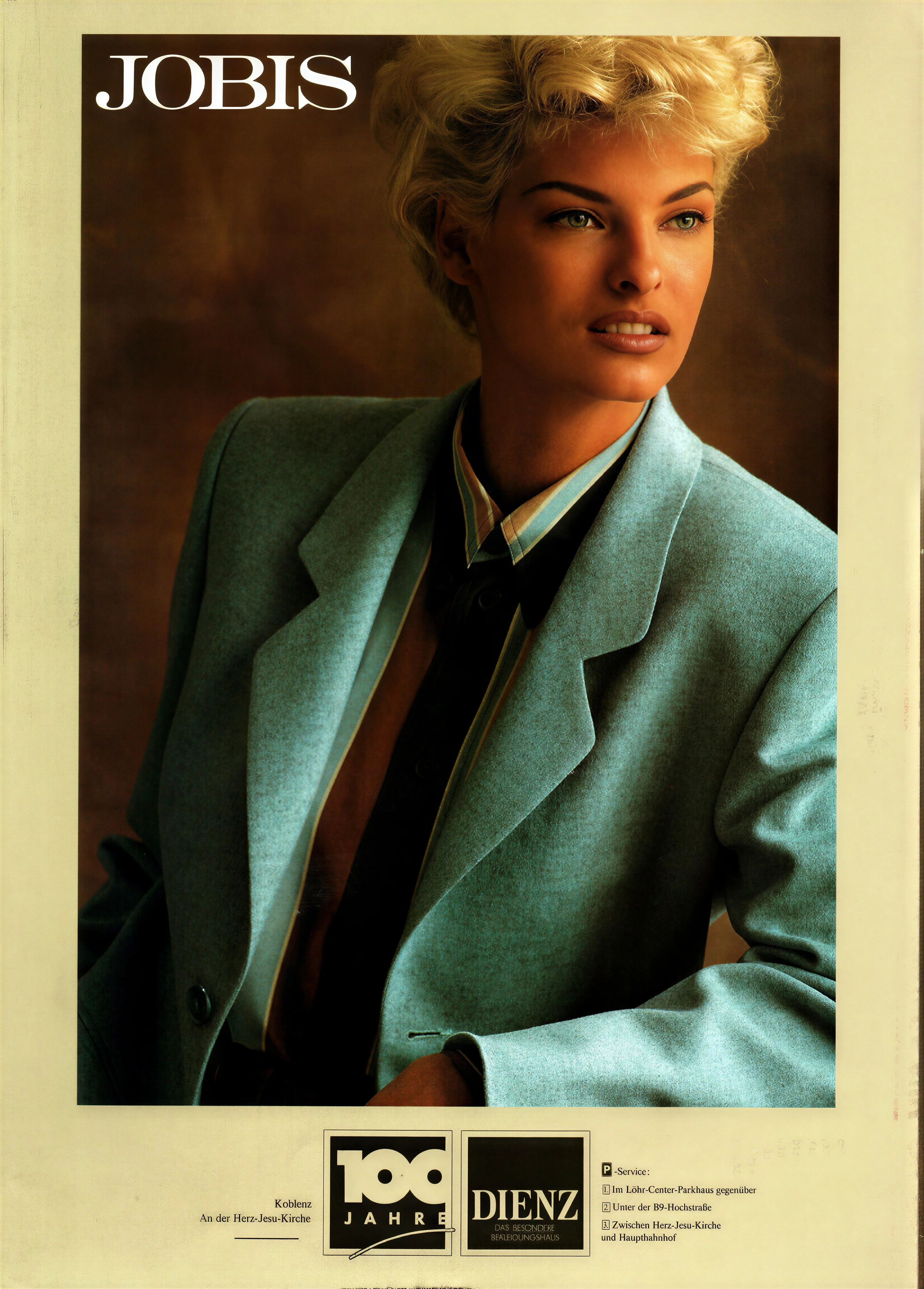
The restraint of the page makes Jobis look like a small label, but it wasn't. Furrier Johannes Bisegger rebuilt his business in Bielefeld after the war; Jobis, a compression of Johannes Bisegger, entered the commercial register in 1947. By 1957 it employed about 1,000 people and ranked among the leading German clothing manufacturers. It made Lufthansa's first post-war stewardess uniforms in 1955, then kept the airline contract for decades. Seidensticker bought Jobis in 1970, so by 1991 this was an established premium label inside one of Bielefeld's major clothing groups, not a hopeful boutique spending its last cheque on a supermodel.
It wasn't chasing teen fashion. The proposition was a complete, expensive wardrobe for a woman who expected clothes to last: firm shoulders, long jackets, skirts at the knee, silk against wool. That made freshness difficult. Change the cut too much and you lost the customer; change the face and you didn't.
I found no campaign brief, but the brown Jobis suit makes the logic unusually plain. Its skirt and peach blouse could have looked dutiful on almost anyone else. On Evangelista they look sharply new. The bottom of both ads belongs to Dienz, a Koblenz clothing shop celebrating its centenary, which suggests these were dealer pages using Jobis campaign imagery. Linda's job was to carry fashion prestige all the way to a regional sales floor.
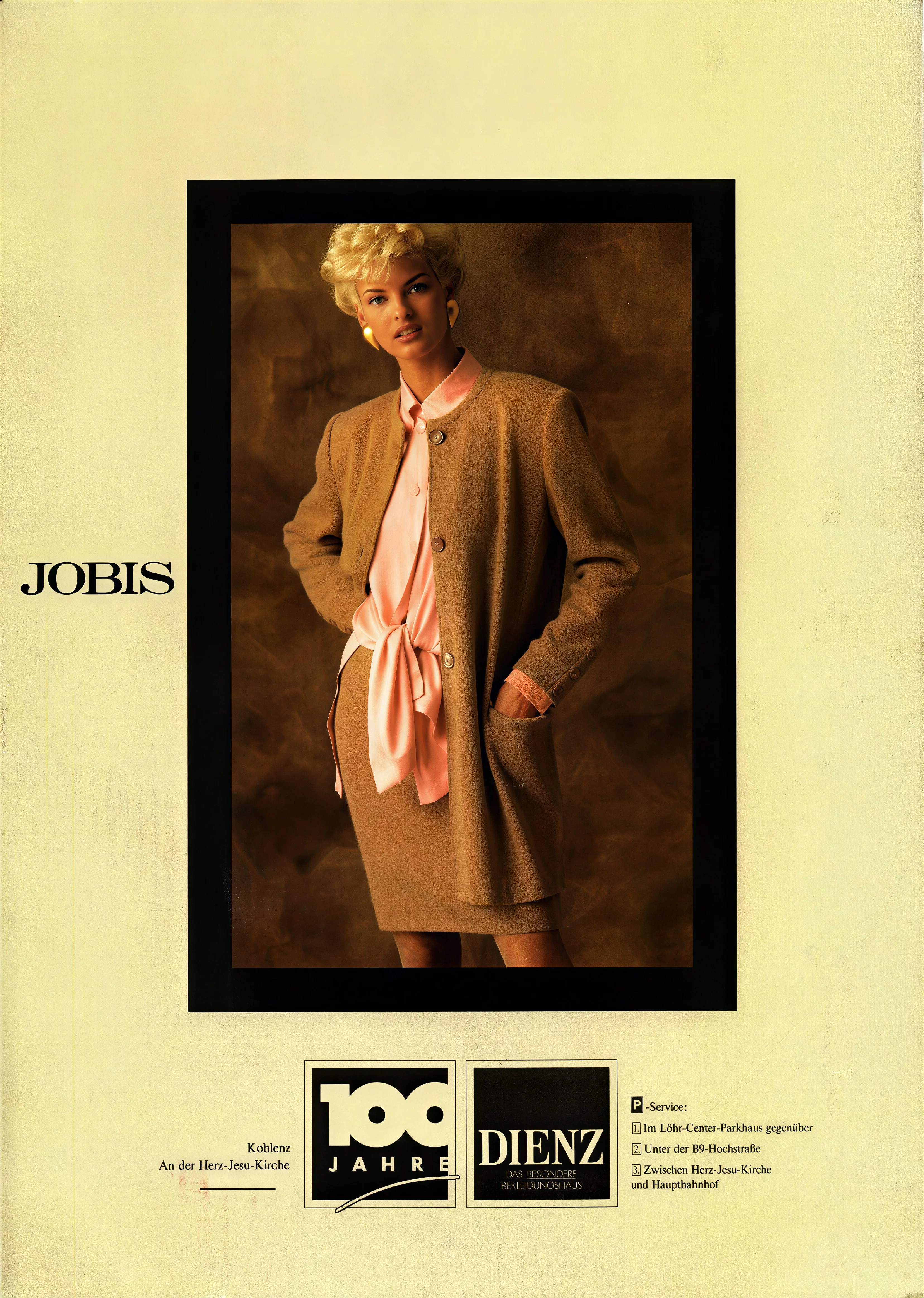
Evangelista was still an extravagant booking. The crop that remade her career had reportedly quadrupled her rate, while the Versace runway, Chanel campaigns and Freedom! '90 made her face legible far beyond fashion readers. But she was also a superb commercial model. She could give a conservative suit a different character simply by changing her hair, posture or expression. Jobis didn't book Linda Evangelista despite selling conservative tailoring. It booked her because she could make conservative tailoring look like the future.
The company lasted another seventeen years. Seidensticker sold it in July 2008 with about 100 employees, around 400 customers and exports above 50 per cent. That was still a real international business. The buyer, Damo, ran into trouble almost immediately; production stopped, insolvency followed and 108 Bielefeld workers lost their jobs. The company was dissolved in 2009, and its legal shell lingered until the register deleted it in 2020 for lack of assets. Jobis isn't still going. The clothes now circulate second-hand, while these pages preserve the moment an old industrial label bought the most modern face it could find.
Sources:
-
Niedergang der Bielefelder Modebranche — Neue Westfälische
-
Seidensticker verkauft Jobis an Damo — TextilWirtschaft
-
Jobis droht das Aus — TextilWirtschaft
-
Witthaus steht der Bisegger-Stiftung vor — Musik- und Kunstschule Bielefeld
-
Hanns Bisegger — Wikipedia
-
Seidensticker Image Folder — Seidensticker
-
Linda: The (Mini) Biography — Back Row
-
JOBIS Bekleidungsindustrie GmbH & Co. KG — Handelsregister
Filed under Jobis · Linda Evangelista
This post is timestamped using Blockchain technology. Verify