What Was in the Box
The April 1990 issue of American Vogue carried a Hermès page worth stopping on: Linda Evangelista down on the floor in a butterfly-print silk dress, propped on one arm, a small orange box cupped in her free hand. The line above her read "Hermès on the rocks." She isn't going anywhere. That's the point of the picture. A woman in couture, mid-afternoon, with nothing to do and nowhere to be, holding something we never quite get to see inside.
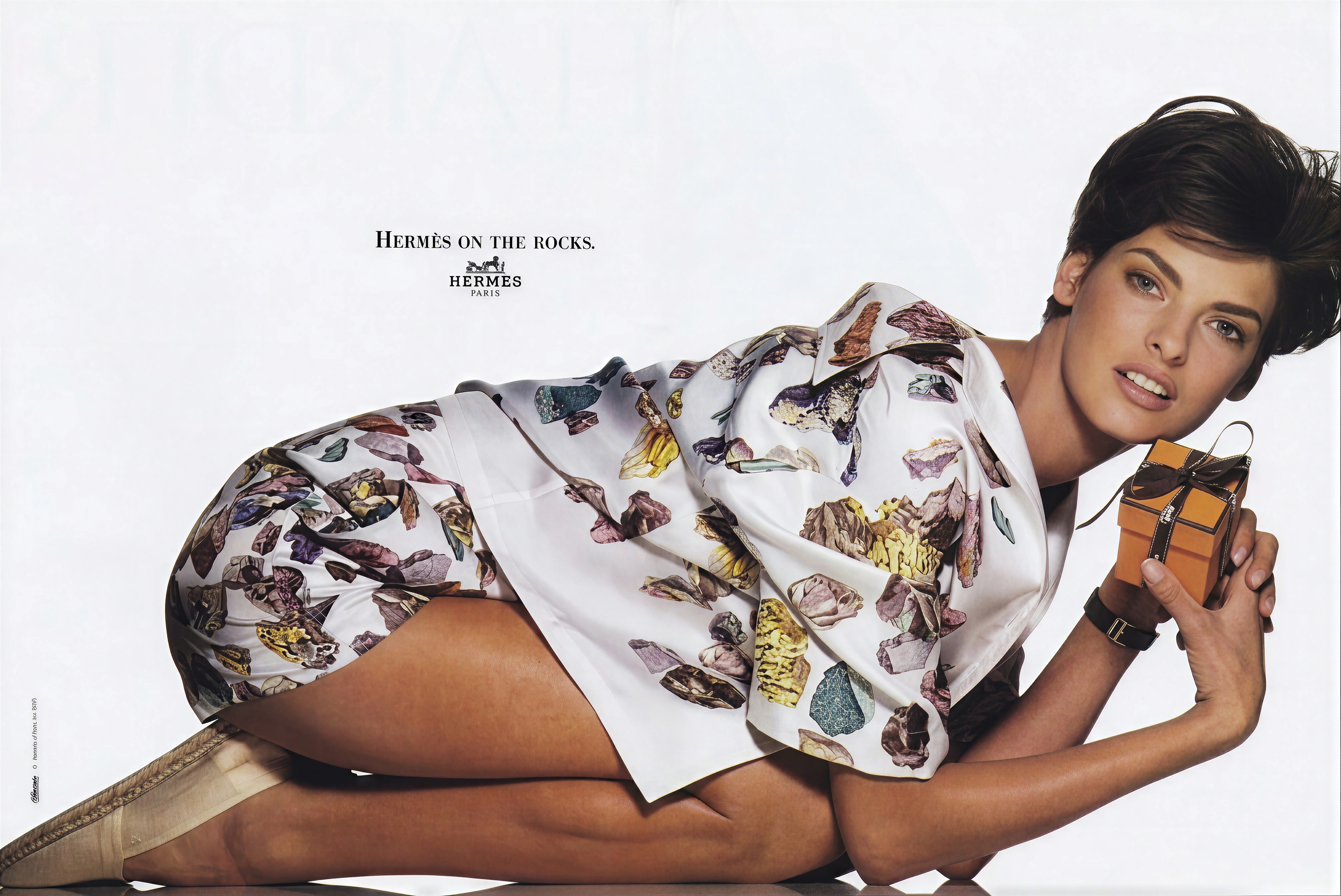
The fantasy here is leisure more than it is any object. The dress costs what it costs, but what the page is really selling is a life with that kind of empty time in it, the time to lie on a floor in silk. Everything about the staging says the money question has already been settled, somewhere off-frame, by someone else.
Now set that against the country reading the magazine. In 1990 the median American family earned around $35,300 a year. Average hourly pay for most workers sat near $10 an hour, and gas was about a dollar a gallon, which tells you how far that wage had to stretch. Real purchasing power had been essentially flat since the early 1970s, so the typical household in April 1990 was not richer than its parents had been, just busier keeping level. The long 1980s expansion still looked intact that spring, but the cracks were there. The savings and loan crisis was unfolding into one of the most expensive bailouts in American history, credit was tightening, and consumer confidence had started to slip. The recession that the economists would later date to that July was already in the post.
So the box. We never learn what's in it, and it doesn't matter, because whatever little trinket was in the box Linda was holding, most women certainly could not afford it. A silk scarf ran to a couple of hundred dollars, two or three days of an average wage for a square of printed twill. The ad isn't blind to that gap. The gap is the product. Hermès wasn't trying to convince the average reader she could join this woman on the floor. It was selling her ninety seconds of being her instead, turning the page into a small holiday from her own arithmetic.
That's the same trick Calvin Klein was running across town, where the advertisement is the product and the thing in the bottle just verifies the receipt. The difference is honesty of scale. Eternity at least sold you a feeling you could take to a counter. Hermès sold you a floor you would never lie down on, in a spring when most of its readers were doing the opposite of resting.
Sources:
-
Prices and Wages by Decade: Quotable Facts — University of Missouri Libraries
-
Early 1990s Recession in the United States — Wikipedia
-
Business Cycle Dating — National Bureau of Economic Research
Filed under Hermès · Linda Evangelista
This post is timestamped using Blockchain technology. Verify