Fifteen Percent Went to Shalimar
The parfum flacon floats over a bare shoulder and the woman selling it is caught in a gilt mirror, cropped dark hair, a red mouth, her eyes going sideways to her own reflection rather than out to you. Other bottles crowd the dressing table at the bottom of the frame. It's a picture about a private ritual, not an offer, and it was made for a fragrance that had been on sale for about seventy-five years by then.
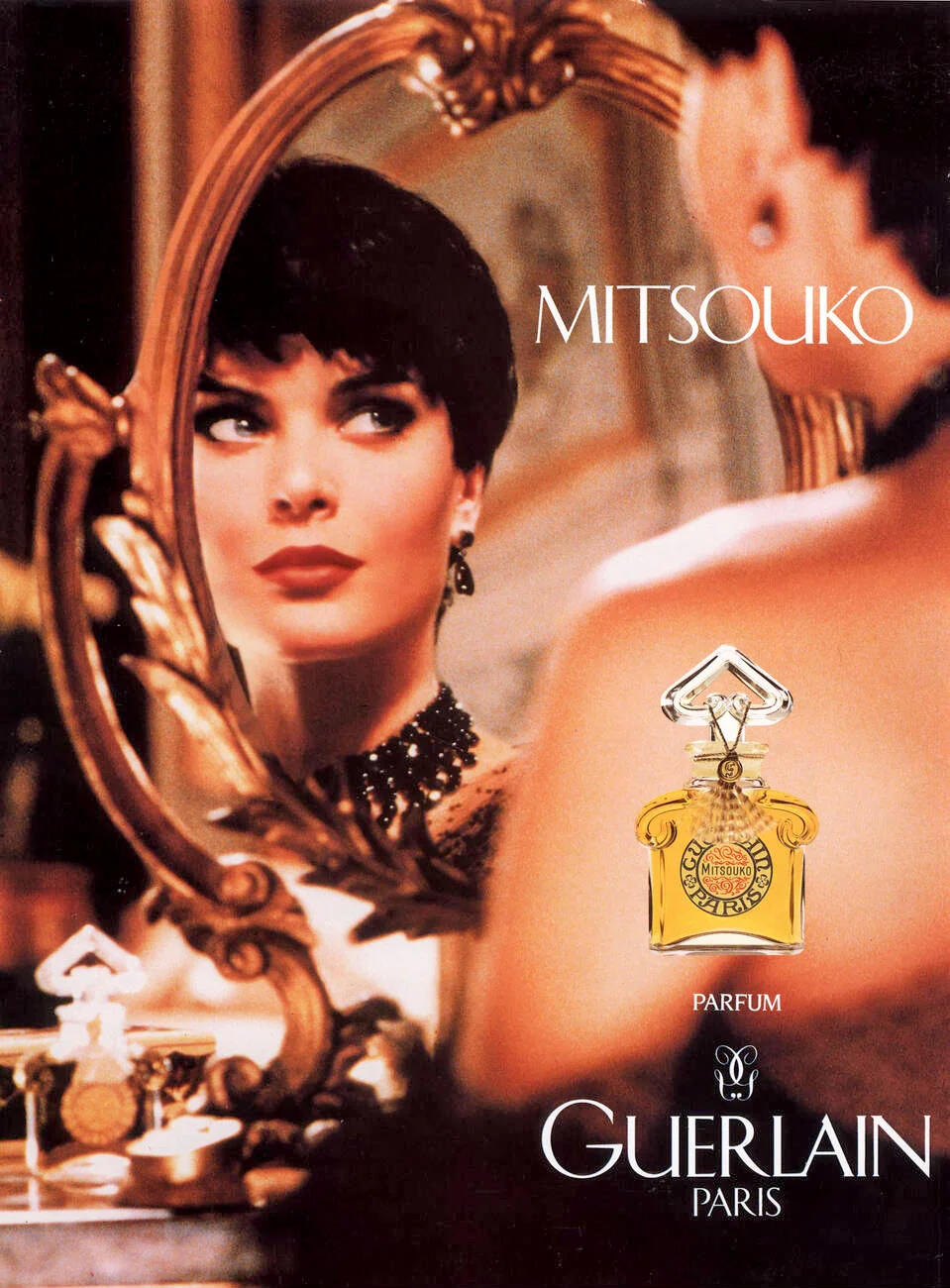
I wanted to name her and couldn't. Five search routes turned up nothing. The closest dated match is Bruno Bisang, who shot Mitsouko for Guerlain in Paris in 1997 and kept two Polaroids from the job, and the entries that follow them in his archive are labelled Monica Bellucci and Claudia Schiffer while the Mitsouko pair carry only the campaign name. That's a photographer's filing habit rather than evidence of anything Guerlain decided, and I can't confirm it's even the same shoot. She stays unnamed and I've stopped pretending that counts as a finding.†
The commercial picture behind the ad is less romantic. Guerlain went into the 1990s turning over around two billion francs a year, profits slipping, its catalogue visibly ageing, the last real hit being Samsara in 1989. By mid-decade Shalimar and Samsara were each running at roughly 15 percent of the house's perfume sales, and perfume was about 60 percent of the business. Mitsouko isn't named in that breakdown. Two flagships at 15 percent leaves seventy percent unaccounted for and the chypre could be sitting anywhere inside it, so this is an argument from silence and not a sales figure. What it does establish is which two names the house reached for when it had to describe itself, and neither of them was the one the critics loved.
That was the business the family sold. LVMH took 58.9 percent of Guerlain in 1994 for close to two billion francs, bought out the remainder by 1996, and valued the house at over four billion in the process. Champs-Élysées arrived that same year, built from a marketing concept rather than composed by a Guerlain nose.
The pressure from outside was worse. Thierry Mugler's Angel launched in 1992 on patchouli, praline, red berries and vanilla, invented the modern gourmand, and went on to outsell Chanel No. 5 in France; CK One followed in 1994. Neither smelled anything like a fruity chypre, and the mass of the market was already running toward clean and aquatic anyway.
Then the material itself was restricted. Oakmoss is the spine of a chypre, and also a skin sensitiser, and IFRA, the industry's own standards body, pushed its permitted level down to 0.1 percent of the finished product by 1997. That forced reformulation rather than deletion, but wearers noticed. A commenter on Perfume Shrine who bought her first bottle in the early 1990s described going back for a replacement and finding it simply wasn't the same, and only learned about the reformulation years afterward.
Which is one way to read that mirror. A house carrying a scent it can't grow and won't discontinue has little reason to pay for a famous face, and every reason to buy a beautiful anonymous one who is looking at herself rather than at you.
Amendment, 26 July 2026. She has a name after all: the woman in the mirror is Tara Westwood, the Canadian model born in Manitoba. The argument above about why Guerlain wanted an anonymous face is mine, not the house's, and it was always weaker than the sales figures. ↩
Sources:
-
Guerlain Company History — Company Histories
-
Polaworld — Bruno Bisang Photography
-
Angel (perfume) — Wikipedia
-
Guerlain Mitsouko: fragrance review & history — Perfume Shrine
Filed under Fragrance · Guerlain · Tara Westwood
This post is timestamped using Blockchain technology. Verify