Spice in an Aquatic Decade
The advertisement gives the game away before you smell anything: a man hides half his face behind an armful of white roses, the amber bottle glowing out of the dark beside a slab of gold lettering. Escada had built its name on women's clothes and women's perfume, the house not yet two decades old and run by Margaretha Ley and her husband Wolfgang. A men's scent in 1993 was a side bet, and it aged better than most of them.
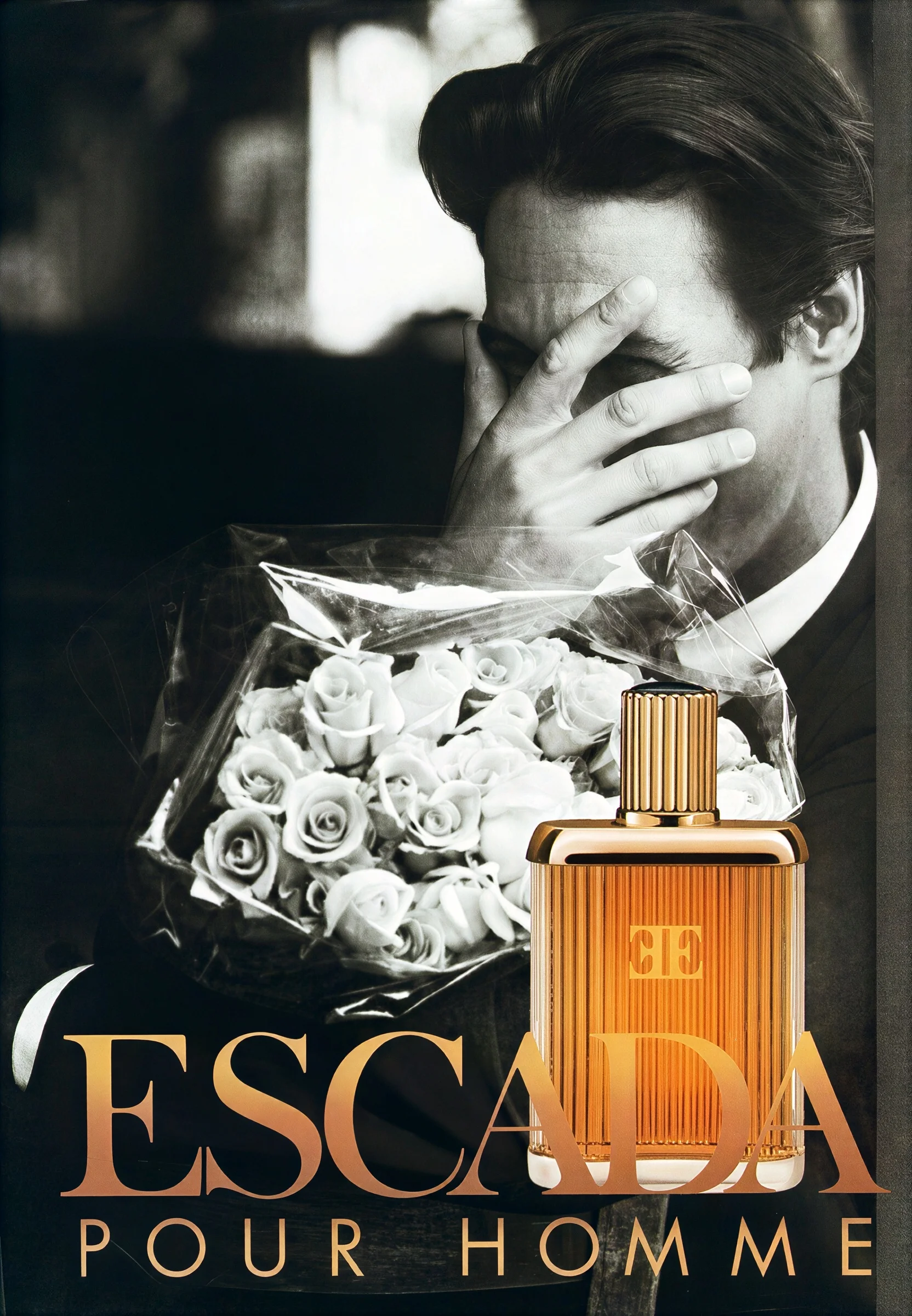
Escada Pour Homme is an oriental, and an unapologetic one. It opens boozy and bright, cognac and citrus over lavender, then settles into a spice drawer: cinnamon, nutmeg, cardamom, caraway, a little carnation and geranium. The base is the warm standard of its decade, vanilla, sandalwood, tonka, patchouli and musk. People who wore it reach for the same words, sophisticated, professional, the thing you'd put on for a boardroom rather than a beach. It was loud, too, the kind of sillage that announced you halfway down a corridor.
The timing is the interesting part. By 1993 the masculine market was already sprinting in the other direction, toward the fresh, clean, faintly aquatic scents that would define the rest of the decade in the wake of Cool Water. Escada Pour Homme ignored the memo. It belongs to an older powerhouse lineage, the warm, spicy school of Tuscany per Uomo and Guerlain's Héritage, a world away from anything ozonic, a spicy oriental arriving just as spicy orientals were going out of style. Being out of step is a good part of why people remember it; there's very little like it being made now, and the people who loved it have nowhere else to go.
Which brings up the part that stings. Escada discontinued it, and the secondary market did what it does to a discontinued cult scent. A used 75ml bottle runs around $120 if you're patient. Sealed 100ml examples ask $200 and up, sometimes well past $250. For a fragrance that once sat on a department-store shelf as a mid-tier designer release, that's a strange afterlife: paying vintage-collector money for something that used to be unremarkable, bought by people who simply liked how it smelled.
That rose bouquet in the ad is an odd prop for a men's fragrance, melodramatic, almost mournful, a man apparently overcome by something. Maybe that was the point. The juice inside is warm and faintly nostalgic even when it was new, and the picture sells that exact feeling rather than anything you could actually bottle.
Sources:
-
Escada pour Homme — Fragrantica
-
Escada Pour Homme 1993 — Australian Perfume Junkies
-
Escada Homme by Escada (1993) — The Scented Devil
Filed under Fragrance
This post is timestamped using Blockchain technology. Verify