What Sportmax Was For
The dress is four triangles of saturated colour meeting at the chest like a Suprematist diagram: yellow at the shoulders, electric blue down one side, magenta across the opposite hip, green filling the lower wedge. Sleeveless, short, built flat. There's no print on any of it. The colour is the surface.
This kind of thing didn't come out of Max Mara. Max Mara sold you the camel coat, the careful tailoring, the unshowy silhouette, the idea that a good Italian house should dress you in things that still make sense a decade later. Sportmax was the other door in the same building. Founded in 1969, built specifically to do the stuff the main line wouldn't: American sportswear cues, Swinging London attitude, experiments the parent label wasn't willing to risk on its own balance sheet.
For a while the experimental credentials were stronger than anyone now remembers. Jean-Charles de Castelbajac, already a committed colour-and-geometry fanatic, directed Sportmax's first runway show in 1976. The pattern continued from there. The house kept its own design hand, mostly uncredited in the press, working somewhat in the shadow of Max Mara's more commercially visible output.
By the early 1990s, Milan had split into two visible camps. Versace at full maximalist volume, and the quieter axis of Armani and Prada teaching the decade how to whisper. Sportmax never fit comfortably in either room. The thing in this picture is not minimalism and not opulence. It's hard-edged geometry used with deadpan confidence: here are four colours, here is how they join, that is all you're getting.
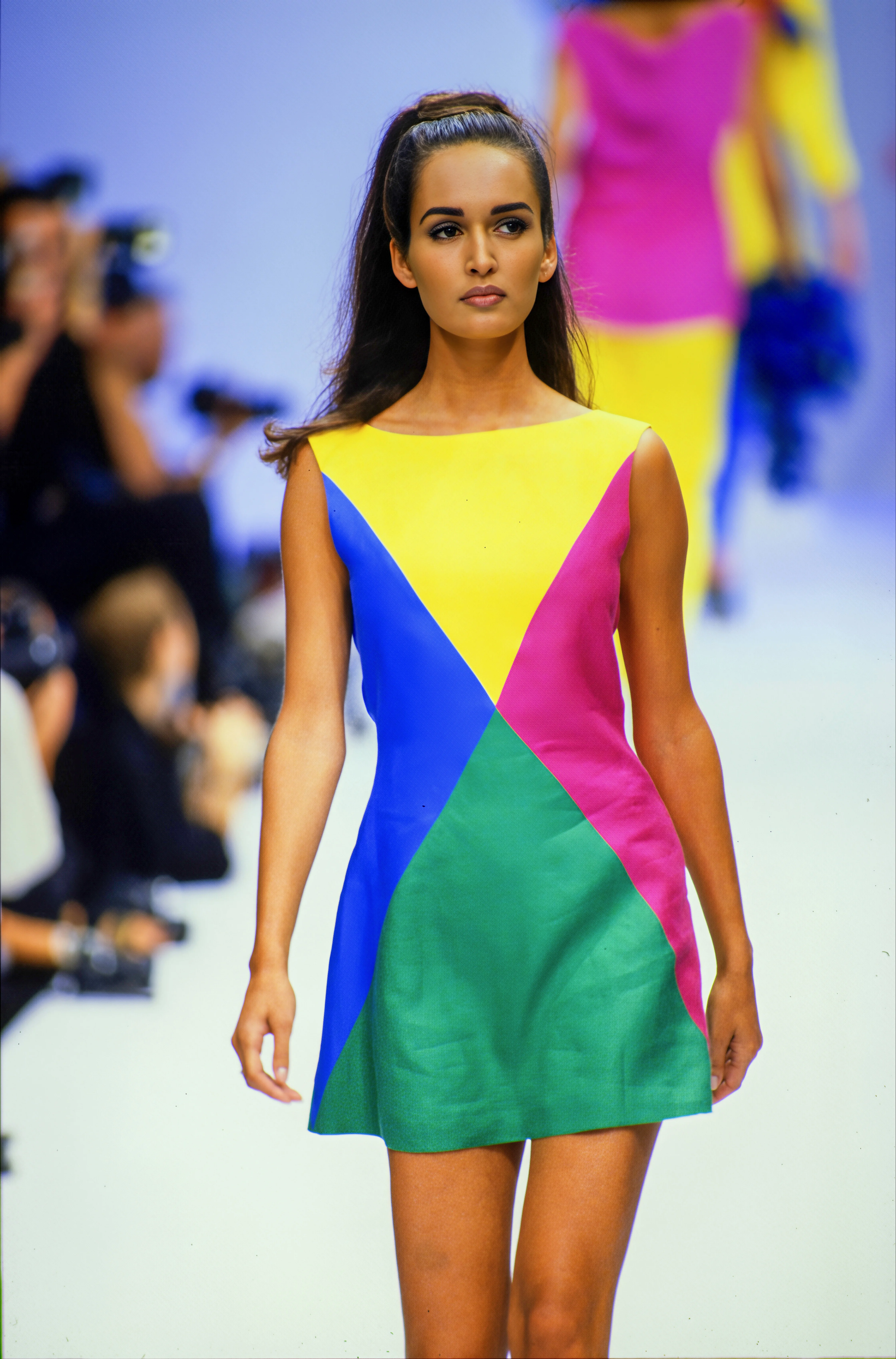
The lineage is real. Yves Saint Laurent's 1965 Mondrian dresses are the obvious ancestor, pieced from flat panels with their seams hidden inside the grid. Issey Miyake's 1980s geometry pushed the same logic somewhere else entirely. Versace was running his own saturated colour work under the Pittura banner, loud and operatic, around the same time as his 1991 supermodel runway. The Sportmax version was quieter and more graphic. A dress that could pass for a diagram.
Colour blocking before it had a name, essentially. The term wasn't in use yet; the technique was. Italy in the early 90s was full of houses trying it without a noun to hang on it. Some of those attempts look dated now. This one doesn't, because the geometry is specific enough to read as architecture rather than trend, four panels, four colours, precisely plotted seams.
Looking at it now, what strikes me isn't the boldness. It's the control. Nothing in the dress is accidental. The hemline is calibrated to the widest point of the green triangle. The straps are narrow enough to keep the yellow reading as a single field. And the camera row in the background, almost by accident, is doing its own quiet colour work behind her shoulder: another pink dress receding into the light, a photographer's dark jacket cutting a vertical edge, nothing in the frame wasted.
There is nothing in this dress that a more cautious house would have made.
Sources:
-
La Révolution Mondrian — Musée Yves Saint Laurent Paris
-
The Gianni Versace spectacle that revolutionised the runway — AnOther Magazine
Filed under Sportmax
This post is timestamped using Blockchain technology. Verify