I. Magnin, Top Left
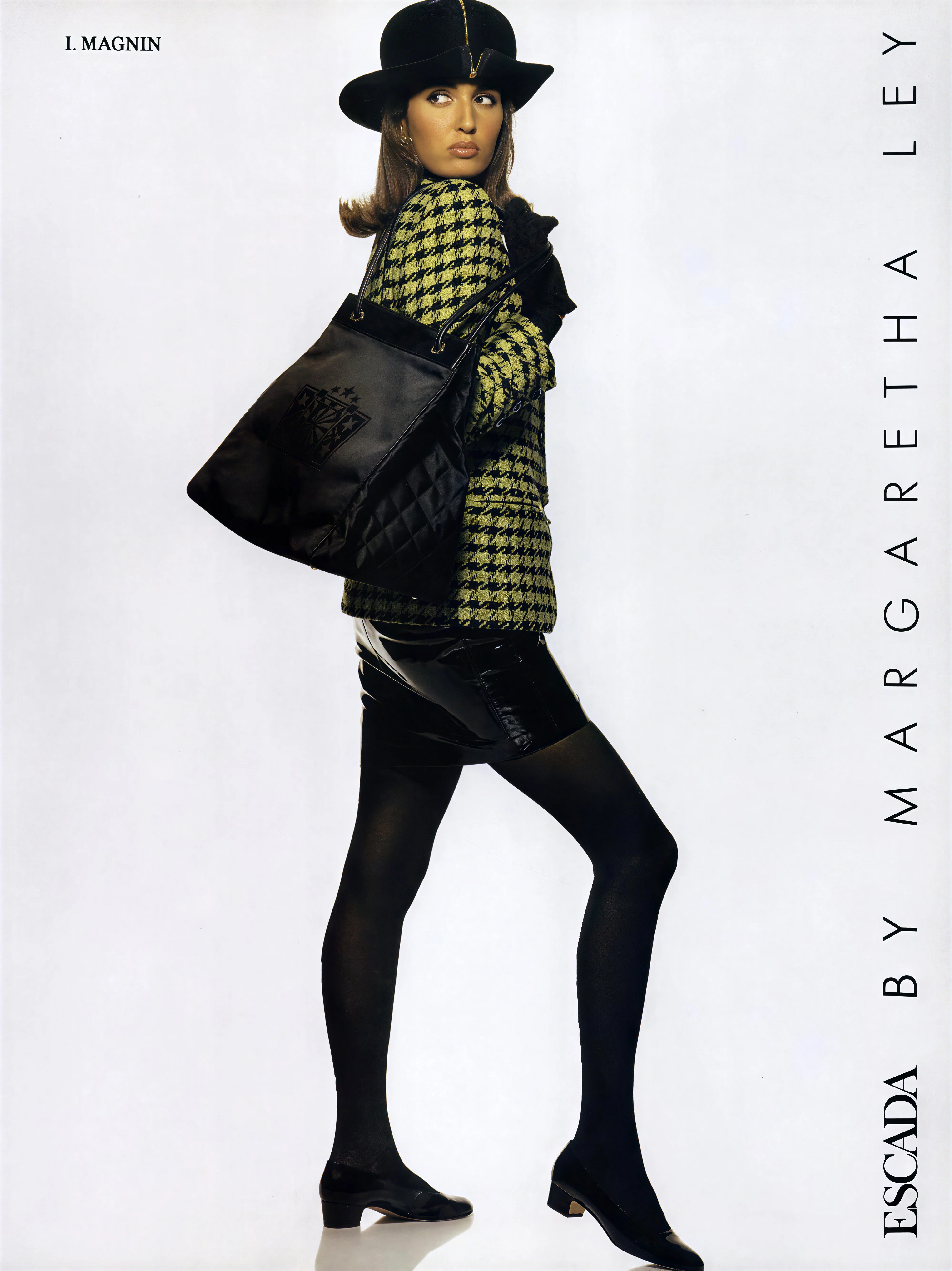
Two names share this page and they are not the same kind of name. Down the right edge, letter-spaced tall enough to read from across a newsstand: ESCADA BY MARGARETHA LEY. Top left, small, serif, doing none of the shouting: I. MAGNIN. One of them made the clothes. The other was where you could buy them.
That top-left line is cooperative advertising. The brand supplies the photograph, a retailer's name goes in the corner, and the two of them split the cost of the page between them. So the same plate can run in a dozen markets with a dozen different shops named on it, which is easiest to see when a label doesn't bother keeping the list to one: Kenar ran a page the year before with a whole row of stores set along the bottom, Bloomingdale's and I. Magnin among them. This page carries a single store, and that is the only variable on it.
Everything Escada supplied is deliberately from nowhere. Gail Elliott crosses a white studio in olive houndstooth over black patent, opaque tights, flat shoes, a bowler tipped forward and a quilted tote you could pack for a weekend, the house emblem stamped into the leather. Her eyes have gone sideways, off the lens and out of the frame entirely. Heavy autumn wool, sold to you in July. No street, no city, no weather, no season matching the one you were reading in.
Which leaves those two words in the corner doing all the locating, and in 1991 they were still carrying real civic weight in San Francisco at least. Mary Ann Magnin founded the store in 1876 and put her husband's initial on it while he peddled the baby clothes she sewed. The Union Square flagship opened in 1948, ten storeys of white marble by Timothy Pflueger, and when Christian Dior toured it he called it the White Marble Palace.
The family had been out of it for nearly fifty years by the time this ad ran. Bullock's bought them in 1944, Federated absorbed Bullock's, and Macy's took the Magnin stores in 1988, four years before filing for bankruptcy protection and beginning to shut them. In November 1994 Federated and Macy's announced the chain would be wound up because it "is not expected to make a meaningful contribution to the combined company's bottom line." A grandson of the founder offered to buy the twelve remaining stores and was refused. Union Square closed on 8 January 1995 and the Chronicle columnist Herb Caen wrote the elegy: "The interior was dazzling, especially the great main hall, two stories high, with its Lalique light fixtures, the gold ceilings, the glass murals, the expensively made cases."
The name down the right edge outlived its author. Margaretha Ley died in June 1992, eleven months after this page ran, and the house spent the rest of the decade insisting on the page that nothing had happened before filing for insolvency in 2009. Seventeen more years of trading on a dead woman's signature, which a brand can do, because a brand is a claim and claims can be maintained. The line in the top left corner had none of that in it. It was an address, and an address is the first thing a merger deletes.
Sources:
-
I. Magnin — Wikipedia
-
I. Magnin & Co. records, 1893-1998 — Online Archive of California
-
Venerable I. Magnin to Pass Into History — Los Angeles Times
-
Macy to Let I. Magnin Pass Into History — Los Angeles Times
-
I. Magnin Department Store — San Francisco Points of Historical Interest
-
Cooperative Advertising — Inc.
-
Margaretha Ley, Chief Designer Of Sportswear Company, Is Dead — The New York Times
-
Escada files for insolvency — FashionNetwork
-
Escada — Encyclopedia.com
Filed under Escada · Gail Elliott
This post is timestamped using Blockchain technology. Verify