Wired Early, Cut to Pieces
Janet Maslin opened her New York Times review on 22 May 1993 by observing that Sharon Stone practising her golf putts was "one of many good reasons this film was kept under wraps until it opened yesterday". Variety filed Sliver as "a cold, inaccessible yarn about murder and voyeurism" and suggested Stone "might be well advised to move on to a different genre". The Los Angeles Times put its verdict in a subheading: a film about voyeurism that doesn't provide much to watch. Read together, the pans have a shape. Almost all of them reviewed the sex and the star, measuring what Stone did here against what she had done the year before in Basic Instinct, and almost none of them reviewed the idea the film was built on.
Paramount's one-sheet had already made the promise the picture couldn't keep. Black field, three names in serif capitals, and down the centre a single vertical strip of blue eye above an orange open mouth, sliced narrow like the building. "You like to watch, don't you." Richard Schickel, in TIME, was the one critic who took the taunt at face value. A cinema screen, he wrote, is "among other things, a big lighted window", and we in the dark are voyeurs hoping to see forbidden sights, which makes Carly Norris a projection of our watching selves: we are invited to watch a watcher learn to like watching. Then he dismissed it as carelessness dressed up as irony. He was right about the film and wrong about the idea. A picture doesn't have to earn its premise for the premise to be the thing worth keeping.
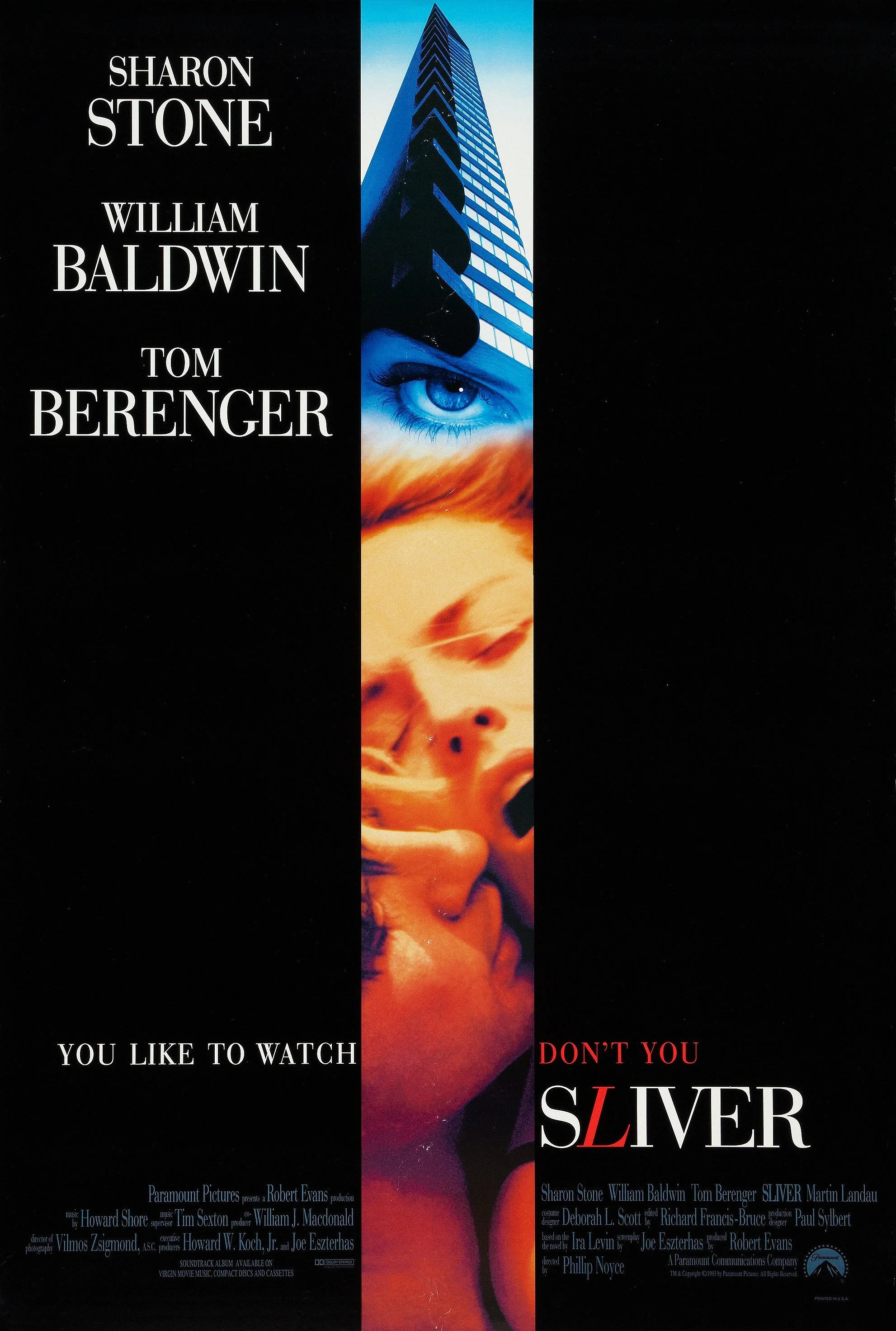
Audiences were not the obstacle. Sliver took $12.1 million across 2,093 theatres, beat Hot Shots! Part Deux to number one, and finished on $36.3 million at home and $123.9 million worldwide against a $40 million budget. The tagline worked exactly as a tagline should. Whatever went wrong here, nobody refused the invitation.
What they bought a ticket to wasn't quite a film. Phillip Noyce has said he made 110 edits to escape an NC-17, and the ending was rewritten and reshot after previews went badly, which meant changing who the killer was. Set that against Malice, five months later, whose plot also collapses when you push on it: Nicole Kidman's malpractice fraud requires a surgeon who was secretly her doctor in Boston under another name, and nobody has ever explained how he ran two identities. That hole is load-bearing. It is the film committing to its own excess. Sliver's holes were cut into it afterwards by people trying to save it, and the finished picture has the distinctive flatness of a story whose secret was swapped out in post.
The surveillance is the part that has aged into furniture. In 1999 a Dutch production company put strangers in a wired house and sold the footage as Big Brother, and what William Baldwin's Zeke Hawkins does from his console became a format, then a genre, then a doorbell people buy for themselves. Watching a bank of tenant feeds now looks less like a psychopathology than a job. The line that has actually curdled is the romance: a woman finds out a man has filmed her in her own flat, and the film treats this as the moment she warms to him. In 1993 that was bad sexual politics inside a thriller. Now it's the only genuinely implausible thing left in it.
Sources:
-
Sliver (film) — Wikipedia
-
Review/Film; Peeping Tom's Guide To Modern Voyeurism — Janet Maslin, The New York Times
-
Basic Instigation? Indecent Disposal? — Richard Schickel, TIME
-
Sliver — Variety
-
MOVIE REVIEW : Erotic Thriller 'Sliver' Leaves a Lot to Be Desired — Los Angeles Times
-
Sex thriller 'Sliver' tops box office — UPI Archives
Filed under Film & TV
This post is timestamped using Blockchain technology. Verify