Bois Noir Was a Rough Draft
Alain Wertheimer wanted something new to wear. That is the origin Chanel's own chairman gave for the fragrance his house quietly put into its boutiques in 1987, and it accounts for nearly everything strange about how Bois Noir was sold. No department stores. No gift-with-purchase, a mechanic Wertheimer loathed. No campaign worth the name. Speaking to Women's Wear Daily that November, he was unusually direct about why houses so rarely bothered with anything difficult: "People want success too quickly. From a fragrance point of view, people like what their memory tells them is good. Memory tells you it's good if it relates to something else you like. When a fragrance is completely different, they're lost."
Jacques Polge had been working toward a masculine scent organised around a single material, sandalwood, since the middle of the decade. The reference point was in the house already: Bois des Îles, Ernest Beaux's sandalwood for women from 1926. Bois Noir was conceived as its masculine counterpart, and the listed ingredients make the ambition plain enough. Mandarin, lavender, rose, coriander, Bourbon vanilla, sandalwood, rosewood, ambrette seed. Rose and vanilla, sold to men, in a market whose commercial leaders at the turn of the decade were Polo, Aramis, Drakkar Noir and Obsession for Men. Nothing about that formula was calculated to move volume, and the distribution model confirms that nobody at Chanel expected it to.
The packaging carried the same refusal. A stopper cut from real wood rather than moulded to imitate it, on a black box with a fine white edge, at a moment when men's fragrance was reaching for lacquer and chrome.
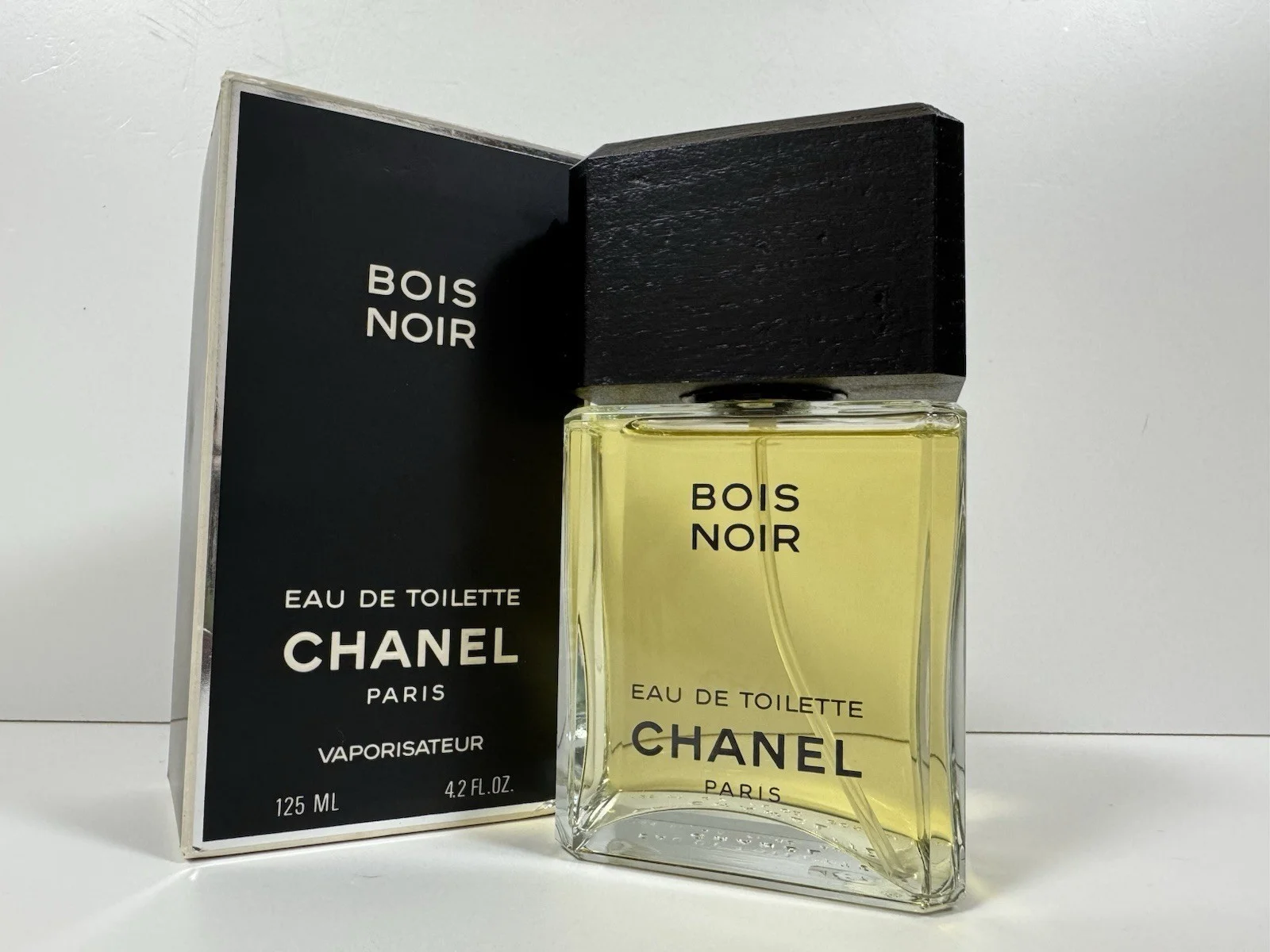
There is almost nothing to weigh as reception, and this is the part the collector literature skips. No contemporaneous criticism, no sales figures anyone has published, no period reviews to set against each other. A perfume sold through a handful of shops, unadvertised, over a run the sources cannot agree the length of, does not generate reception in any useful sense. What gets reported as the reception of Bois Noir is almost entirely retrospective, assembled from the 2000s onward by people writing about decants poured from bottles bought twenty years earlier. That is not worthless, but it is testimony about a heavily aged liquid, gathered from a self-selecting group who had already decided the thing was worth hunting.
Nobody can fix the dates either, and the disagreement is more telling than any single date would be. Now Smell This says the launch was discreet and the fragrance was taken out of production quickly. Raiders of the Lost Scent puts the circulation at 1987 to 1989. Perfume Intelligence records it as discontinued in 1990, on the rebrand, and files it under the flat verdict "not a commercial success." A Fragrantica feature dates the Paris boutique sale to March 1986 and so disagrees with everyone about the beginning as well. Four accounts of a Chanel product from within living memory, and they cannot fix either end of its life. That is what withdrawal without announcement looks like in the record: a scent can be sold by one of the most documented houses in fashion and still leave a gap where its dates should be.
What followed is well documented, because Chanel chose to document it. In April 1990 the fragrance returned as Égoïste, the name bought from Nicole Wisniak's photography magazine because the marketing department found Bois Noir insufficiently provocative for a global launch. Paris was papered with posters carrying the single word JE before anyone knew what was being advertised. Jean-Paul Goude directed the commercial, which used no male models at all and took the Golden Lion at Cannes. It was the largest campaign the house had ever mounted for a men's fragrance, and it went into department stores, which is to say it inverted every decision made about Bois Noir three years earlier.
Then Égoïste's sales dropped rapidly, and Chanel's explanation to the trade press was that it had proved too sophisticated for the American market. That line deserves the same scepticism as anything the collectors say. It flatters the house, blames the buyer, and arrives with no figure attached in any account I can find. Whatever the cause, the house acted on a different diagnosis: by 1993 the name was on Égoïste Platinum, a clean citrus-herbal developed with consumer test groups, which Chanel had not used before. Platinum became by some distance the better known of the two, and still is. Wertheimer had said in 1987 that people like what their memory tells them is good, and six years later his own house was convening test groups to find out what that was.
The myth now runs in the opposite direction to the evidence. Bois Noir is treated as a lost masterpiece, prices have gone somewhere absurd, and fakes circulate freely, usually slightly evaporated Égoïste decanted into a vial. Yet the most careful comparison anyone has published came back the other way. Kevin at Now Smell This gathered samples from two separate original bottles, plus a third from a trusted vendor as a control against a bad decant, and reported that Bois Noir is not that different from Égoïste: richer and denser, and recognisably the same fragrance that is still in production today. I quoted that review here years ago.
So the collector economy has spent three decades grading a working version. A draft can beat the finished piece, and I've no quarrel with the people who prefer this one. But the premium is being paid for rarity, and rarity here was manufactured by a distribution decision rather than earned by the liquid. Compare it with Kouros, launched six years earlier and written off in a newspaper headline ten days after its launch party, which then sold continuously for forty-five years while the oakmoss and civet it was built on were regulated out from under it. Collectors chasing a 1981 bottle are chasing materials that genuinely are not in the current formula. Bois Noir was tweaked and renamed rather than gutted by regulation. Richer and denser is a real difference, and I can't tell you whether it comes from the formula or from thirty-nine years in glass, and neither can the market, because almost every comparison being made is a 1987 bottle against a current one, where age and formula move together. That ambiguity is the whole trade. What age does to a fragrance is doing at least some of the work connoisseurship claims for itself, and a 1987 sandalwood that has sat in glass this long will read deeper and stranger than a current production bottle whatever was in it to begin with.
Sources:
-
Chanel Bois Noir ~ fragrance review — Now Smell This
-
Chanel Egoiste & Platinum Egoiste ~ fragrance review — Now Smell This
-
Égoïste — Wikipedia
-
A Chanel Egoiste guide for collectors — Raiders of the Lost Scent
-
Bois Noir — Perfume Intelligence
-
The Story of a Selfish Man — Fragrantica
Filed under Fragrance · Chanel
This post is timestamped using Blockchain technology. Verify