Borrowed Weather
Page 186 of the August 1992 German Vogue carries a line of white capitals across its lower right corner: "Echte Liebesaffären brauchen nicht nur rote Rosen. Kleine Streitereien und Notlügen sind genauso wichtig." Real love affairs need more than red roses; small quarrels and white lies matter just as much. Along the right edge, in type you need decent light to read, the magazine says where it came from: a Sophia Loren quote, lifted from Doug McClelland's StarSpeak: Hollywood on Everything. The page spells him Dough.
McClelland's book had come out in 1987, three hundred-odd pages of film people talking about everything except, mostly, films. It's a reference shelf item, the sort of thing a features desk keeps for exactly this purpose. Five years on, someone at Vogue went looking in it for a sentence to hang over a photograph of a woman in a printed tunic, and came back with Loren on the upkeep of love affairs. The line has nothing to do with the clothes, which is more or less the point. The caption isn't describing the picture. It's supplying a mood the picture is meant to have already, and borrowing an Italian film star's authority to do it, in a story titled La dolce vita.
The misspelling is the tell. A magazine that proofed its fashion copy down to the buttons, naming the manufacturer of a hair clip, let the author's name through wrong, because the author was never the part being bought. The quote had to sound like Loren and feel like the Mediterranean. Where it actually came from was administrative, and you could print that slightly wrong and lose nothing you were paying for.
The credits don't sit on this page either. They're four pages back, at the head of a ten-page run: Fotograf Michael Roberts, Moderedakteur Susanne Kölmel, with hair and make-up across the whole story by Susanna Rizzi for Aldo Coppola. Here Fabienne Terwinghe is backlit and half-smiling, chin propped on one hand, her hair blown into a corona that takes nearly all the light in the frame. Everything is tungsten and amber. The tunic reads black until the ochre shapes cut across it start behaving like a second light source.
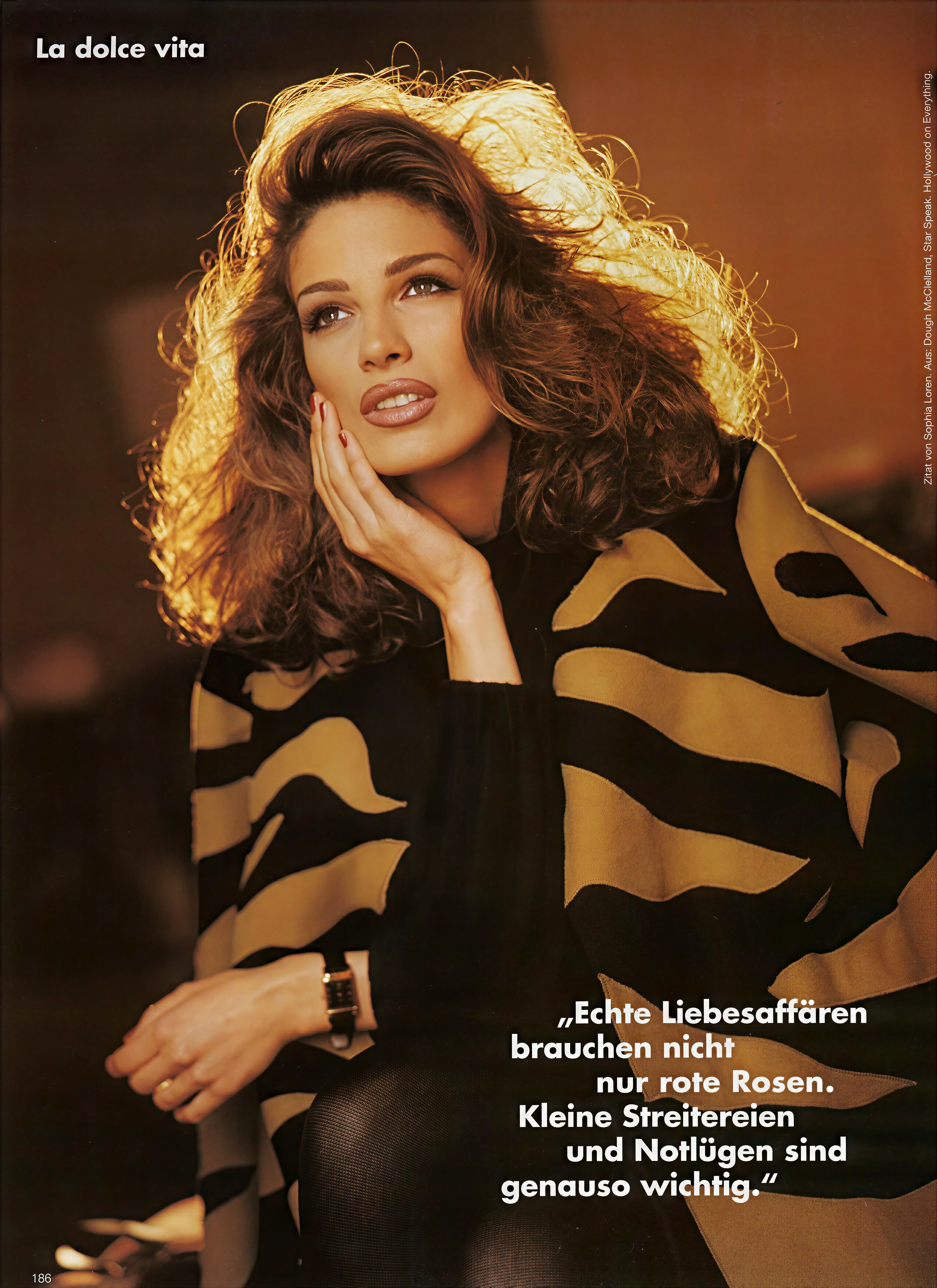
Terwinghe is the surface all of this gets applied to. Belgian, born in 1968, she reached 180cm at fourteen and has said the height made her miserable at the time, because of the teasing. She worked steadily through the late eighties and nineties without ever being installed as one of the era's official faces. Julie Anderson was in much the same position, all over the fashion press of those years with the name rarely attached to the picture. That August issue makes the hierarchy plain enough: Linda Evangelista on the cover, shot by Mario Testino, Terwinghe ten pages deep in the middle. The cover sells a name. The interior sells a feeling, which is precisely the job the borrowed sentence turns up to do.
Michael Roberts took the photograph, which is a stranger credit than it looks. He wasn't a fashion photographer by trade so much as a writer and illustrator and stylist who did all of it at once: Tatler's art director, British Vogue's design director, later the first fashion and style director at Vanity Fair and the only one the New Yorker ever had. Someone who spent a career deciding what belonged next to what, making the picture that a secondhand sentence would then be laid across. He died in 2023, in Taormina.
Sources:
-
Fabienne Terwinghe — Wikipedia
-
List of Vogue Deutsch cover models — Wikipedia
-
Die VOGUE-Cover des Jahres 1992 — Vogue Germany
-
StarSpeak: Hollywood on Everything — Internet Archive
-
Michael Roberts obituary — The Guardian
Filed under Fabienne Terwinghe
This post is timestamped using Blockchain technology. Verify