Petrol and Violets
The first thing most men met was not the smell but that burning horizon: a lone figure on a jetty, walking into a sky the colour of a struck match. Dior called it L'homme infiniment, the man, infinitely. The picture sold solitude and distance. The liquid inside the bottle delivered something far stranger, a masculine that smelled, quite openly, of gasoline.
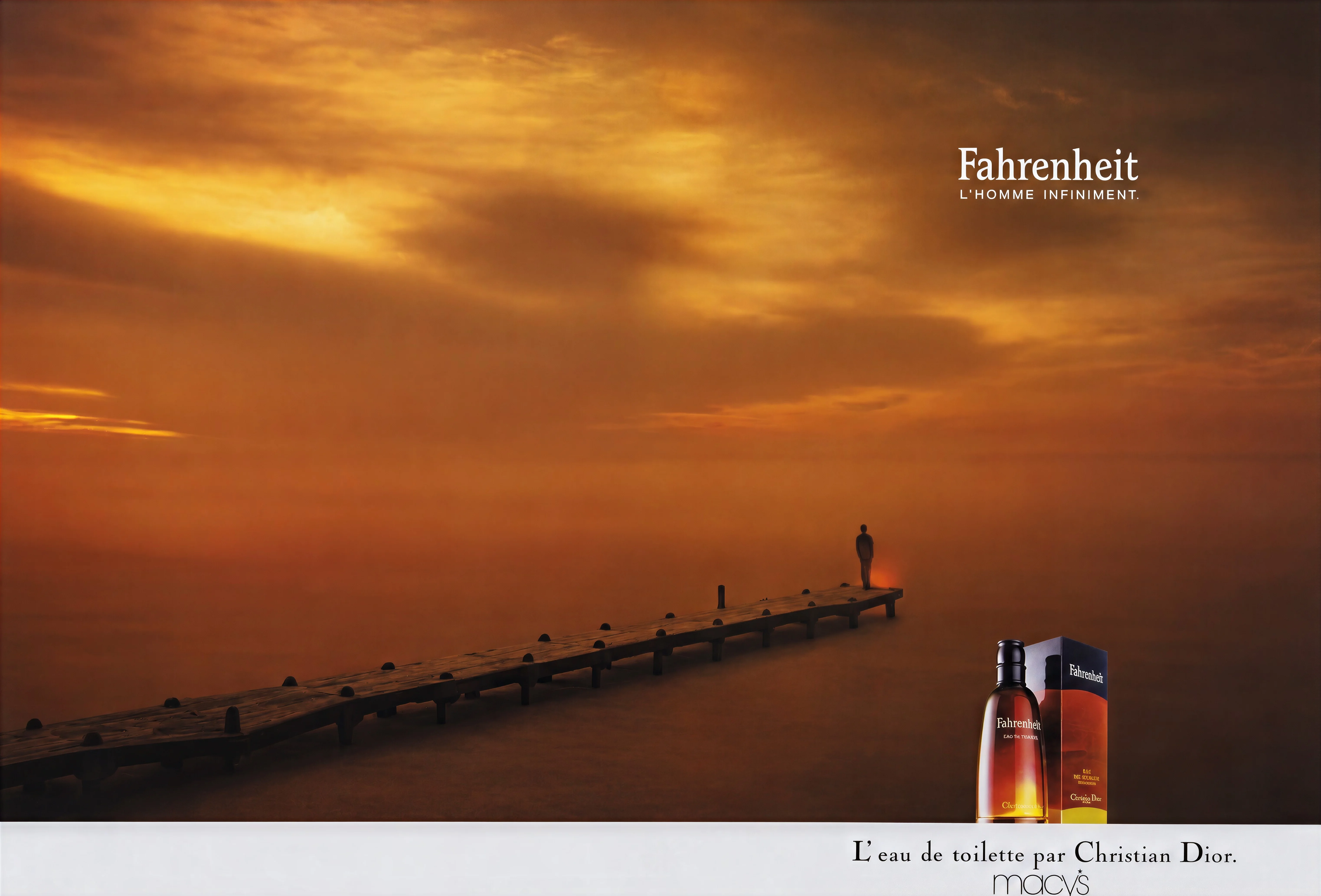
Fahrenheit arrived in 1988, and its origin has been retold so often it now sounds like folklore. Several perfumers were competing for the next Dior masculine, and none of the submissions won outright. The rejected trials were tipped into the same waste barrel and left outside, where sunlight did the rest. When someone came back to it, the barrel had cooked its contents down into a single accord so arresting that Dior had the thing analysed and built a fragrance around what the sun had made. Whether it happened quite that cleanly hardly matters now. Fahrenheit's signature was found rather than designed, and it smells like it. Rebuilding an accident on purpose is harder than inventing something from scratch, and the seams still show: the fragrance never resolves into a single tidy idea.
The fragrance is usually credited to Jean-Louis Sieuzac and Michel Almairac, developed under Maurice Roger, who ran Parfums Christian Dior from 1981 to 1996. They reached for a violet-leaf ester called folione and dosed it at a reckless 0.6 percent, a material so sharp and chemically unstable it had been all but abandoned for decades. That is the "petrol" everyone argues about: not fuel exactly, but the green, metallic bite of crushed violet leaf pushed to an extreme. The team took visual cues from two James Rosenquist paintings that carried the Fahrenheit name, hot and cold held in the same frame. You can smell that tension on skin. Cool hawthorn and honeysuckle up top, a warm floral heart of carnation and muguet, then leather, dry wood and tonka settling underneath. It moves from apology to argument as it dries down. Even the bottle carried the thermometer conceit, a flacon graded from cool bronze at the shoulders to a molten amber at the base, the same fire the ad put in the sky.
To feel how odd this was, remember what men were actually wearing in 1988. The decade belonged to the powerhouses: Kouros, Drakkar Noir, big loud things built to fill a lift and announce a shoulder pad from across the room. Fahrenheit walked in carrying honeysuckle and violets, notes most marketing departments would have filed under "feminine," and refused to apologise for either. Its closest relatives were antique leather scents like Knize Ten from 1924, nothing sitting on the shelf beside it. It was green, floral, androgynous and faintly industrial, and it sold by the tanker-load regardless. Dior had form here. Its previous benchmark pour homme, Eau Sauvage from 1966, had rewritten masculine freshness two decades earlier; Fahrenheit was the house betting that its men would follow it somewhere much darker, and they did.
Here the fragrance stops being a curiosity and becomes a paradigm. It proved that a mainstream men's scent could be genuinely strange, could smell of things nobody could quite name, and still outsell almost everything on the counter. What it did not do was start a movement. Plenty of houses gesture at "violet leaf" now; none commit to it the way the original did, and the full accord has never really been bettered, or even convincingly copied. Stand Fahrenheit next to a modern crowd-pleaser like Bleu de Chanel, all sanded-down sandalwood and focus-grouped freshness, and you can feel how much risk has quietly drained out of the category since. It was a point of no return that almost nobody else chose to cross.
It still sells, which creates its own problem. Regulations tightened on exactly the raw materials that made the original sing, and the reformulations have thinned it; longtime wearers hunt vintage bottles the way record collectors chase original pressings, reading batch codes and cellophane wraps to date a flacon to its year. It is also one of the most counterfeited scents in the business, which tells you how much residual worship still clings to the name. Even flattened, it holds a shape no other bottle on the counter has. A minute with the older juice explains why a whole generation dates the smell of the early nineties to it, and why so many people say Fahrenheit was the thing that made them care about perfume in the first place. It became an institution without ever quite becoming safe.
The advertisement got there first: a man alone at the edge of a jetty, lit by a sky about to catch fire, facing away from everything behind him. Nearly forty years later, it is still the only bottle on the counter that smells like walking out there.
Sources:
-
Fahrenheit: All About the Fragrance and a Bit About the Thermometer — Fragrantica
-
Fahrenheit (perfume) — Wikipedia
-
Fahrenheit by Christian Dior (1988) — The Scented Devil
Filed under Fragrance
This post is timestamped using Blockchain technology. Verify