Erreuno and the Invisible Factory
In this 1992 advertisement, Yasmeen Ghauri reclines in a cream belted suit while the Erreuno logo runs across the bottom like bent chrome tubing. The clothes are expensive but not spectacular: soft shoulders, a broad printed collar, enough fabric to make ease look deliberate. It is a good image for a house that prospered without developing an equally durable public identity.
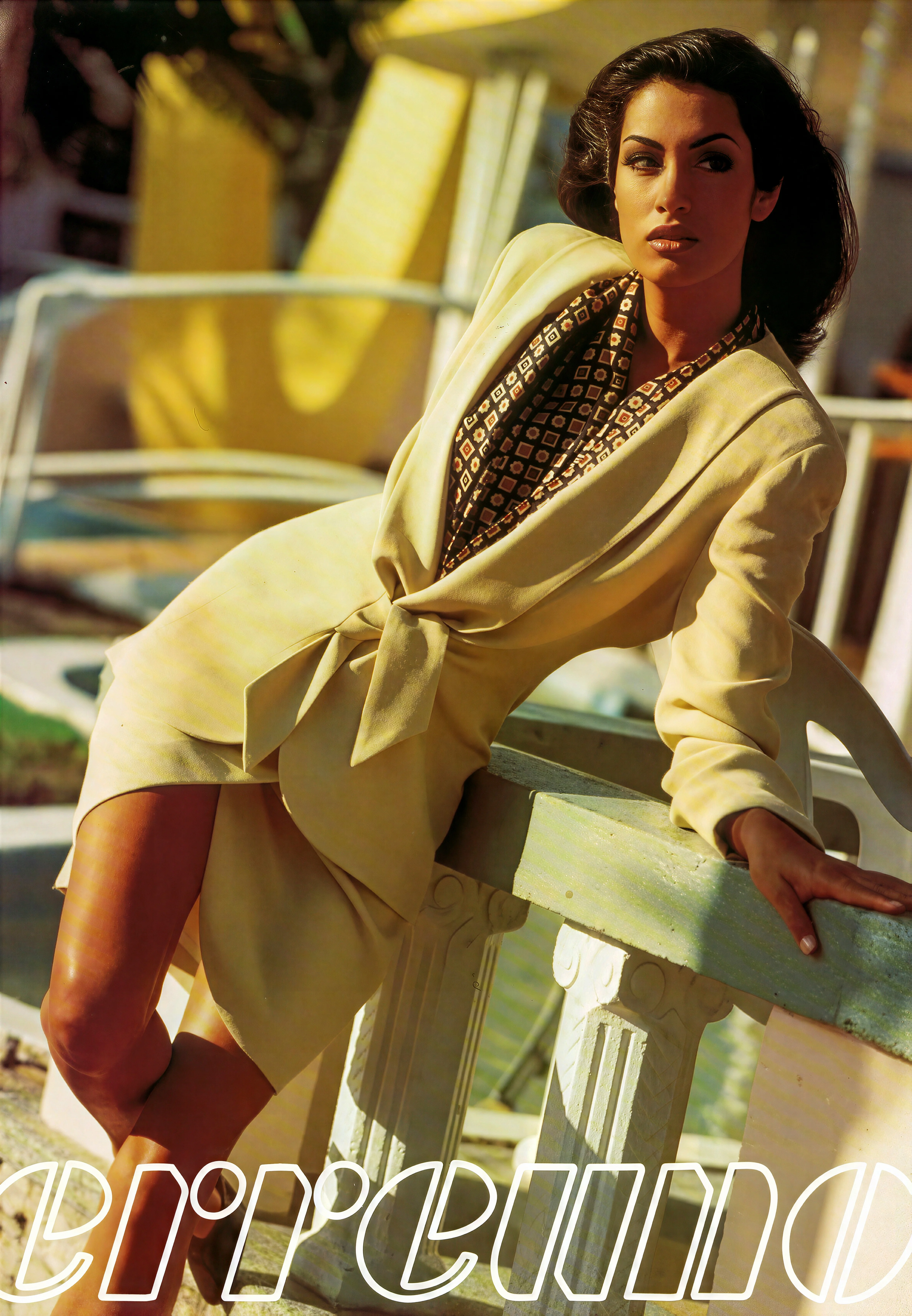
Ghauri gives the picture more voltage than the garment asks for. By 1992 a recognisable model could lend an unfamiliar label some of her own visibility. The setting offers sun, painted garden furniture and the suggestion of somewhere expensive. No Italian monument, no obvious narrative. Erreuno lets the atmosphere and the clothes remain pleasantly unresolved.
Ermanno and Graziella Ronchi founded Erreuno in Milan around 1970 or 1971. The sources disagree by a year. The name joined the Italian pronunciation of R, erre, to uno: Ronchi's first venture. According to the fashion reference MAM-e, the business began in a basement, with Ermanno selling and Graziella designing, then grew by visiting provincial boutiques rather than waiting for Milan to notice.
The decisive move was to treat the label as a meeting point between factory, fabric, and outside designer. Gianmarco Venturi worked on its ready-to-wear in the 1970s. Giorgio Armani designed for Erreuno from 1980 to 1988, when his own name was already becoming shorthand for relaxed authority. A contemporary Washington Post report described buyers rising to applaud Erreuno's 1982 collection of blousons and unexpected gold, then identified Armani as its power broker. Erreuno gave that language another production platform: tailoring softened until a woman could move inside it.
Graziella's role mattered because she translated runway ideas back into usable clothes. That practicality remained after Armani left. The house developed its own fabrics, mixed checks and stripes, and stayed between his restraint and the more theatrical Milan of Versace. Ghauri's suit belongs to that middle ground. The robe-like closure is relaxed, but the patterned collar keeps it from disappearing into beige. It resembles the other Armani that fashion memory often edits out: fluid rather than corporate.
Michael Kors designed Erreuno J, introduced to the American market in 1990, another revealing hire. The house expanded into menswear, jeans, accessories, golf and fragrance, exporting almost half its production at one point. Yet breadth did not produce a symbol comparable to an Armani jacket or a Versace Medusa. A Politecnico di Milano study describes Erreuno as internationally recognised in the 1980s and 1990s, then inactive for more than twelve years before an archive-led relaunch.
Erreuno belongs to the industrial history of Made in Italy more than its hall of fame. Designers supplied recognisable handwriting; manufacturers, textile researchers and sales networks turned it into a business. The Ronchis built a house sturdy enough to carry Armani, Venturi and Kors, yet flexible enough that each could leave traces. The label faded. The system it represented became the Italian fashion industry.
Sources:
-
Erreuno — MAM-e
-
Leather & Gold: A Crowd-Pleasing Show in Milan — The Washington Post
-
Erreuno SCM SpA — Contemporary Fashion
-
Erreuno: Reviving an Italian Fashion Brand Through Its Heritage — Politecnico di Milano
Filed under Giorgio Armani · Erreuno · Yasmeen Ghauri
This post is timestamped using Blockchain technology. Verify