Two Bristols: Concrete Time
Some cities present themselves neatly. Others only reveal themselves from the side, in the service road, under the bridge, behind the civic building where nobody was meant to linger. Bristol, perhaps more than most, belongs to the second category. Its public face is easy enough to identify: Clifton, the bridge, the harbour, Georgian terraces, student cafes, hills, postcard drops of light over the Avon Gorge. But there is another Bristol too, harder, stranger, more provisional. A Bristol of underpasses, concrete walkways, civic backsides, rain-stained walls and fluorescent windows. These two photographs seem to hold both versions of the city in suspension.
The first image, taken behind the old police station in 1984, is almost aggressively unpicturesque. It is not trying to charm anyone. There is no harbour glimmer, no terrace elegance, no "historic Bristol" being offered up for approval. Instead, we are in one of those back-of-city spaces that British urban planning produced in abundance after the war: a narrow road hemmed in by brick, concrete, office windows, walkways and shop units. The city not as spectacle, but as infrastructure.
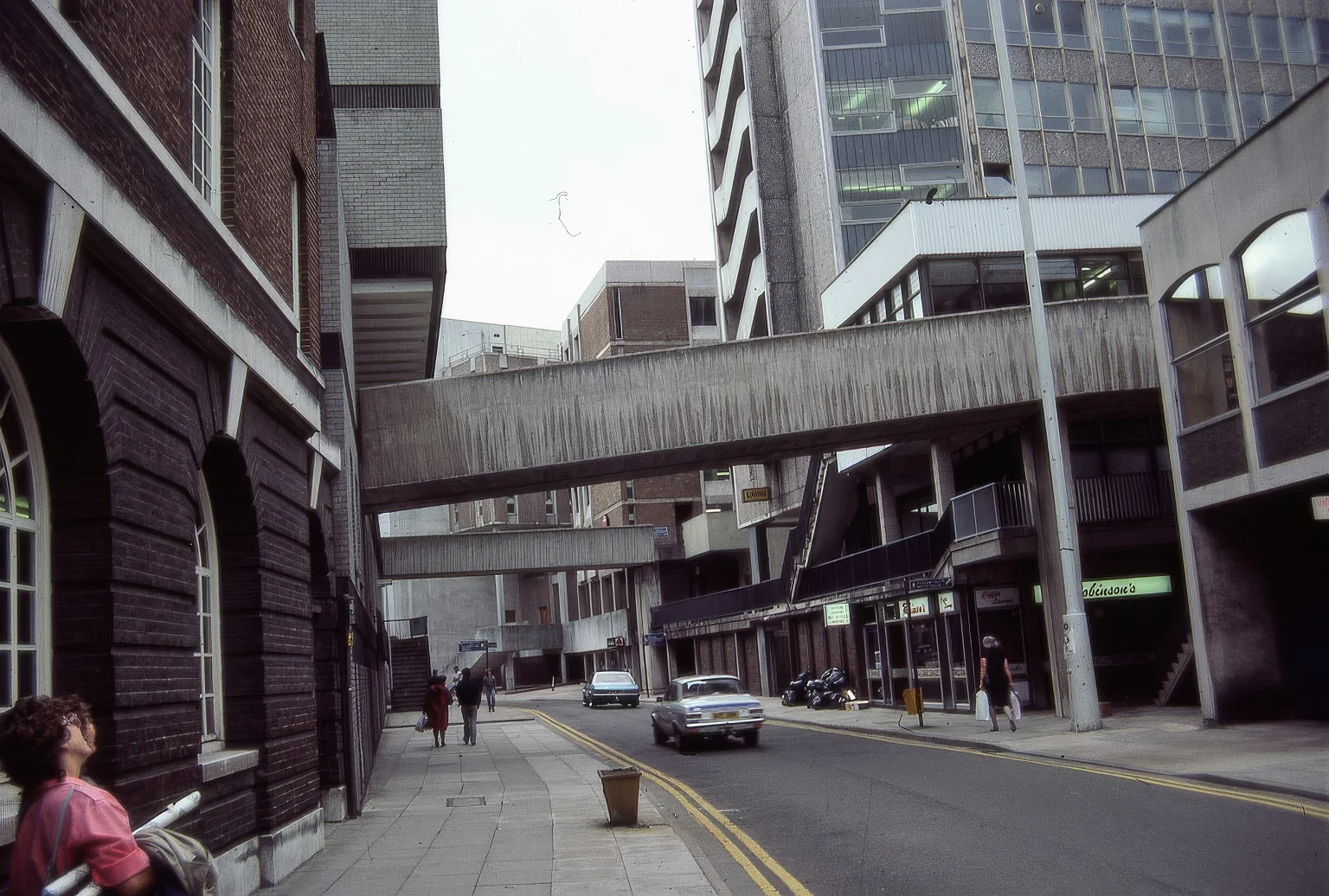
Overhead, enclosed bridges cross the street like institutional arteries. They do not invite you to look up so much as remind you that the real business of the place is happening elsewhere, behind glass, above street level, in corridors and offices. The street below feels like a leftover channel, somewhere you pass through rather than arrive in. Even the shops have the air of temporary tenants in someone else's plan.
And yet the photograph is compelling precisely because of this ordinariness. The mundane details now become the emotional charge: the bin in the road, the dull double yellow lines, the small shop signs, the pedestrians walking away, the faint glow of interior lights in an office block. Nobody in the scene is posing for history. Nobody seems aware that this ordinary Bristol afternoon will one day become almost unrecoverable.
That is the peculiar ache of such images. The past is rarely arranged like a memory while we are living through it. It is mostly made of errands, side streets, dead time, unremarkable buildings and moments spent going somewhere else. Later, these overlooked places become portals. The unattractive becomes precious because it was not preserved for us. It survived only by accident.
The old Bridewell site has a longer and messier history than the photograph needs to explain. The Island's own account says the Central Police Station complex was built in 1928 and opened as a police station in November 1930, on Nelson Street, near the site of an earlier station. By the time this picture was taken, the building was already moving toward its afterlife. Avon and Somerset Constabulary had been created in 1974, headquarters functions started moving out the following year, and the remaining CID offices left in 1986 when the New Bridewell Police Station was completed across the road.
So the photograph catches the place in a particular middle condition. Not historic yet. Not dead. Not quite modern anymore.
The image has the mood of municipal modernism after the optimism has drained out of it. Those concrete walkways once belonged to a future: efficient, elevated, planned, rational. By 1984, they already look tired. The rain has found them. The concrete has darkened. The dream of circulation and civic order has become a damp canyon behind a police station.
It is easy to mock this kind of architecture, and often it deserves it. But the photograph does something subtler. It shows the melancholy dignity of a failed future. These buildings were not ancient, not yet ruins, not still new. They occupied that strange middle age of the urban landscape, when yesterday's progress has become today's background.
If that first photograph is Bristol as back corridor, the second is Bristol as apparition. The Clifton Suspension Bridge, seen from the bottom of the Avon Gorge in February 1992, is familiar and unfamiliar at once. The bridge itself is instantly recognisable, but the angle changes everything. We are not up at Clifton Observatory, not on the elegant side of the city, not looking at a tourist view. We are down below, at river level, where the gorge is steep and shadowed, where the road runs tight against the cliff and the Avon withdraws into mud at low tide.
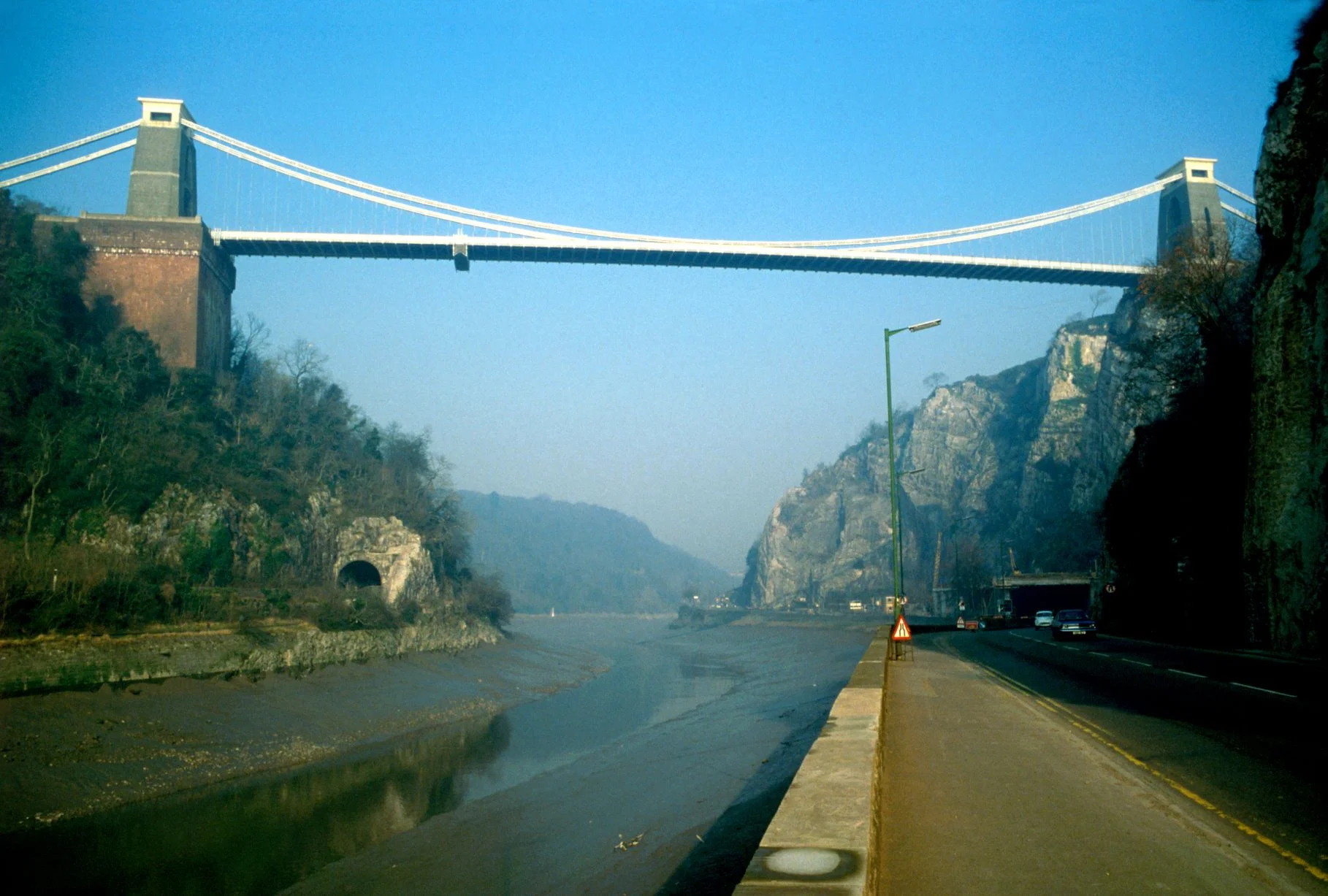
From here the bridge appears almost impossible: a thin white line drawn across blue air, suspended between two enormous masses of stone. It is more idea than object. The road, cars, tunnel mouth, lamp post and warning sign pull the scene back into the early 1990s, but the bridge itself seems to exist outside the photograph's date. It belongs to another scale of time.
That contrast is what makes the image work. The gorge is geological time. The bridge is Victorian time. The road is twentieth-century time. The cars are 1992. The photograph is now memory. All these layers sit together in one frame, and none of them fully cancels the others.
The light helps. February light can be cruelly beautiful: pale, cold, clarifying. Here it gives the scene a kind of blue distance. The trees are bare, the river is low, and the gorge recedes into haze. It does not feel cosy or picturesque. It feels like a threshold, a place of departure, arrival, passing through. Bristol as a gap between rock and sky.
The bridge is an obvious icon, but the official history is stranger than the iconography. The Clifton Suspension Bridge Trust describes it as a bridge completed after Brunel's death by John Hawkshaw and William Henry Barlow, opened on 8 December 1864, and still maintained through the toll system. That helps explain why the photograph feels layered rather than merely scenic. The bridge is a Victorian engineering object that still carries daily traffic, a tourist image that remains a working piece of infrastructure. It is not just looked at. It is used.
The two images seem, at first, to have little in common. One is cramped, grey, urban, almost claustrophobic. The other is open, blue, monumental. One shows the city's discarded modernity; the other shows its enduring icon. One belongs to the service entrance, the other to the civic myth. But they share something essential: both are images of things that continue without us.
This may be why photographs of places can feel more unsettling than photographs of people. A face declares its vulnerability. A building, a bridge, a road, a cliff, these simply remain. They do not mourn the versions of us who passed through them. The city carries on, altering itself, erasing itself, repainting itself, demolishing one decade and marketing another.
The first photograph may show a Bristol that has largely vanished: shops renamed, buildings altered or demolished, walkways removed, traffic systems changed. The second shows a Bristol that still appears to exist, because the bridge remains. Even there the continuity is deceptive. The exact February air is gone. The particular cars are gone. The quietness of that road, the colour of that film stock, the early 1990s atmosphere, all gone. The permanent landmark only makes the vanished details more visible.
We think we want the monument, but it is often the incidental that hurts. A lamp post. A shop sign. A road marking. The shape of a bin. The colour of fluorescent light in an office window. The precise shade of a winter sky in 1992. The old city does not return as a grand historical narrative. It returns as texture.
There is also a faintly hauntological quality to both images. Not because they show ghosts, but because they show futures that failed to remain future. The 1984 street is haunted by the post-war promise of planned urban life. The 1992 gorge is haunted by the Victorian sublime, by the idea that engineering could draw a perfect line across a natural void. In both cases, the image contains a vanished confidence.
And yet neither photograph is simply nostalgic. Nostalgia often tidies the past. These images do not. The concrete street is bleak. The gorge road is not romantic in any soft sense. The river mud is exposed, the shadows are hard, the urban fabric is compromised. What makes them moving is not that the past was better. It is that the past was real, physically, stubbornly real, and yet is now unreachable.
You could go to Bristol now and stand near these places. You could find the bridge, walk the gorge, search for the old police station area, compare street views, identify what changed and what survived. But you could not step into either photograph. You could not recover the smell of the street behind the police station in 1984, the sound of those cars, the exact rhythm of that weekday. You could not re-enter February 1992, with that blue air and those shadows and that particular version of the Avon below the bridge. The laws of physics, annoyingly, remain firm on this point, and time refuses planning permission.
What remains, then, is the photograph: not a doorway, but evidence. Evidence that these arrangements of matter and light once existed. Evidence that the city had these moods. Evidence that people passed through them, mostly unaware that they were moving through what would later become history.
Together, the two images form a small portrait of Bristol's split personality. Bristol the concrete back passage; Bristol the sublime gorge. Bristol the failed precinct; Bristol the impossible bridge. Bristol as damp municipal afterthought; Bristol as suspended dream. The real city is the tension between them, the place where a stained concrete walkway and a world-famous suspension bridge can belong to the same emotional geography.
Cities store time unevenly. Some things endure. Some things are erased. Some survive but no longer mean what they meant. And some, by being photographed almost casually, become more vivid after they have disappeared than they ever were when they stood before us.
Sources:
-
History of the Old Bridewell Police Station, Artspace Lifespace / The Island
-
About Us, Clifton Suspension Bridge Trust
Filed under Hauntology & the uncanny
This post is timestamped using Blockchain technology. Verify