Couture at Tati Prices
Jules Ouaki called it the Galeries Lafayette du pauvre. His store on boulevard Rochechouart sold clothes from open bins, no salespeople, price tags on the fabric. Tati. Every Parisian knew the pink-and-white vichy check on the awnings and shopping bags. It was the uniform of bargain Paris, visible from the elevated Métro at Barbès, carried by travellers stuffing oversized bags at Orly airport before flights home to North Africa.
In 1990, the painter Julian Schnabel was driving through the 18th arrondissement with his friend Azzedine Alaïa when he spotted the Tati storefront. Schnabel wanted the gingham for a series of paintings. Alaïa negotiated the fabric rights and discovered something he hadn't expected: Ouaki, like himself, was Tunisian.
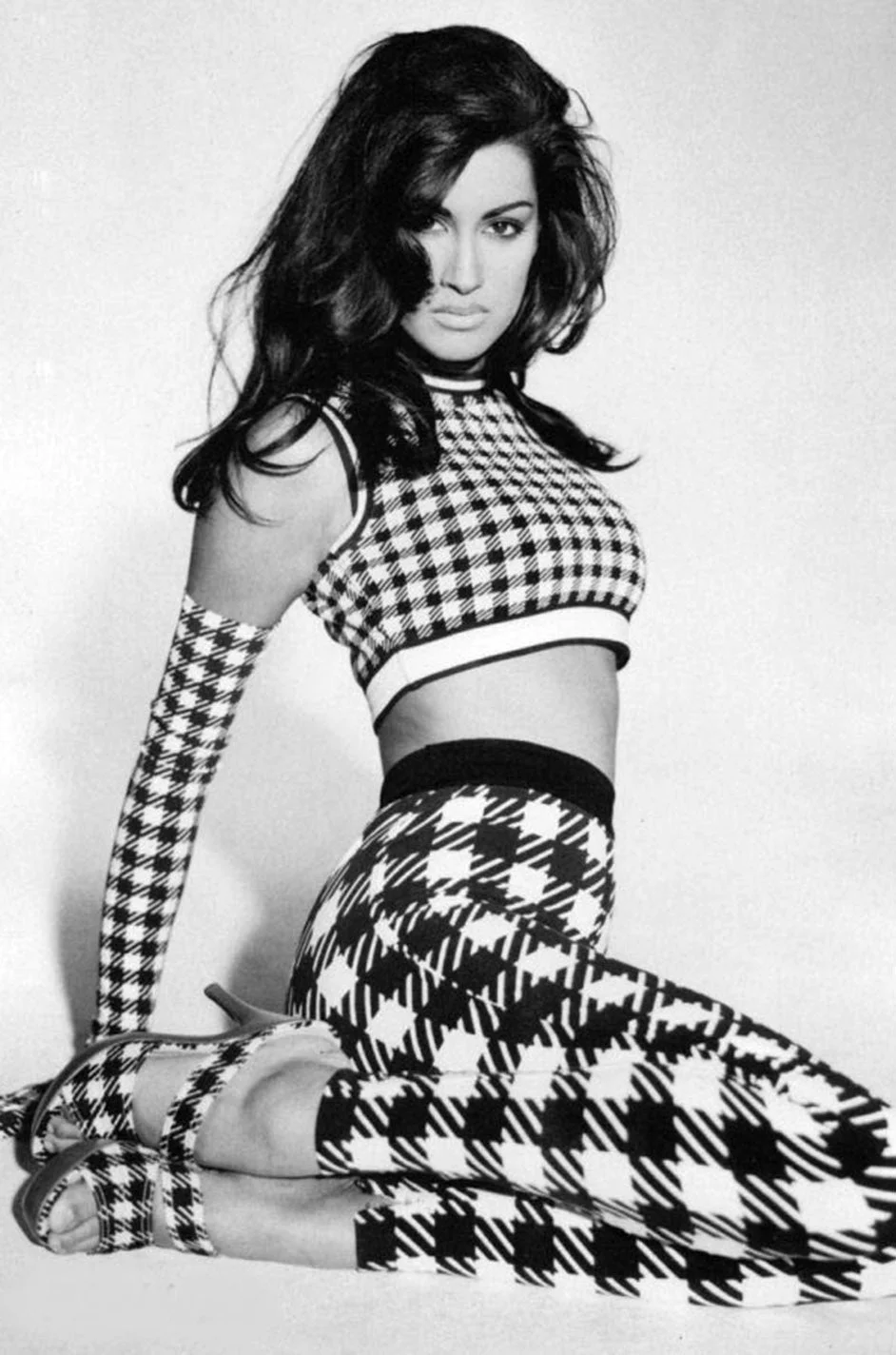
Yasmeen Ghauri in the Tati check, shot by Patrick Demarchelier for Vogue, sits somewhere between couture editorial and cultural provocation. Body-hugging crop tops, hot pants, and leggings cut from discount store fabric using techniques borrowed from the ateliers. Alaïa expanded beyond the signature pink, adding black-and-white and blue variations, but the effect held: couture silhouettes in a pattern every shopper at Barbès recognised from the plastic bag in their hand.
The Spring/Summer 1991 show ran at his atelier on rue de la Verrerie in the Marais, weeks after the official Paris schedule had ended. He hadn't shown on the calendar since the late 1980s. Editors came anyway. Helena Christensen, Elle Macpherson, Carla Bruni, Yasmin Le Bon, Yasmeen Ghauri, and Farida Khelfa all walked. The same year that Valentino staged his thirtieth anniversary in Rome, Alaïa was running gingham from a discount bin through a couture atelier on his own clock.
He also made a capsule for Tati's actual stores: a bag, a T-shirt, a pair of espadrilles, all at Tati prices. "What excited me was to attach my name, and the world of haute couture, with this brand that represented bargain clothing." The capsule items didn't survive. Too cheap, too disposable. The couture pieces ended up in a Fondation exhibition three decades later.
What strikes me about the Tati collection isn't that it anticipated the luxury-streetwear crossover by thirteen years. It's that the crossover wasn't a strategy. Alaïa had watched Tunisian families at Orly hauling those pink bags home. Running Tati's fabric through his atelier was solidarity dressed as fashion.
"With Tati," he said later, "I learned many things. Another way to look at fashion."
His sister Hafida died in 1992. Alaïa withdrew from public fashion for the rest of the decade. Tati itself closed in 2020.
Sources:
-
How Azzedine Alaïa Popularized Street Style in High Fashion — Surface Magazine
-
Check Marks the Spot: Alaïa's Spring 1991 Tati Collection — ReSee
-
Azzedine Alaïa, Another Way to Look at Fashion — Fondation Azzedine Alaïa
-
Remembering Azzedine Alaïa's Influential 1991 Tati Collection — PAPER Magazine
Filed under Azzedine Alaïa
This post is timestamped using Blockchain technology. Verify