Two Hundred Musicians and the Sound of Samsara
Geinoh Yamashirogumi was not a band. It was a collective of over two hundred people, scientists and engineers and students, led by Tsutomu Ohashi, a professor of agricultural chemistry who composed under the name Shoji Yamashiro. Their 1986 album Ecophony Rinne is structured as a four-movement symphony tracing the Buddhist cycle of samsara: primordial germination, death, dormancy, reincarnation. That description makes it sound academic. It isn't.
The first movement opens with something that resembles the universe waking up. Synthesised gamelan, programmed on Roland D-50 and Yamaha DX7-II keyboards because standard MIDI couldn't handle the slendro and pelog tuning scales of Indonesian tradition, collides with field recordings from Central African forests and Buddhist mantras captured with binaural microphones. Javanese jegog bamboo percussion sits alongside pipe organ patches built from sampled Tibetan horns. None of this should cohere. It does, somehow, in a way that feels less composed than geological.
The album's impossible cover art gives you the right frame of reference: mythological, dense, deliberately overwhelming. Kristoffer Cornils at HHV called it "one of the positively strangest, most alluring albums of all time," and for once the hyperbole fits. The record aligns with Jon Hassell's Fourth World concept, blending indigenous forms with electronic processing, but the scale here dwarfs anything Hassell attempted. Two hundred people is not a studio experiment. It is an institution committing fully to an idea.
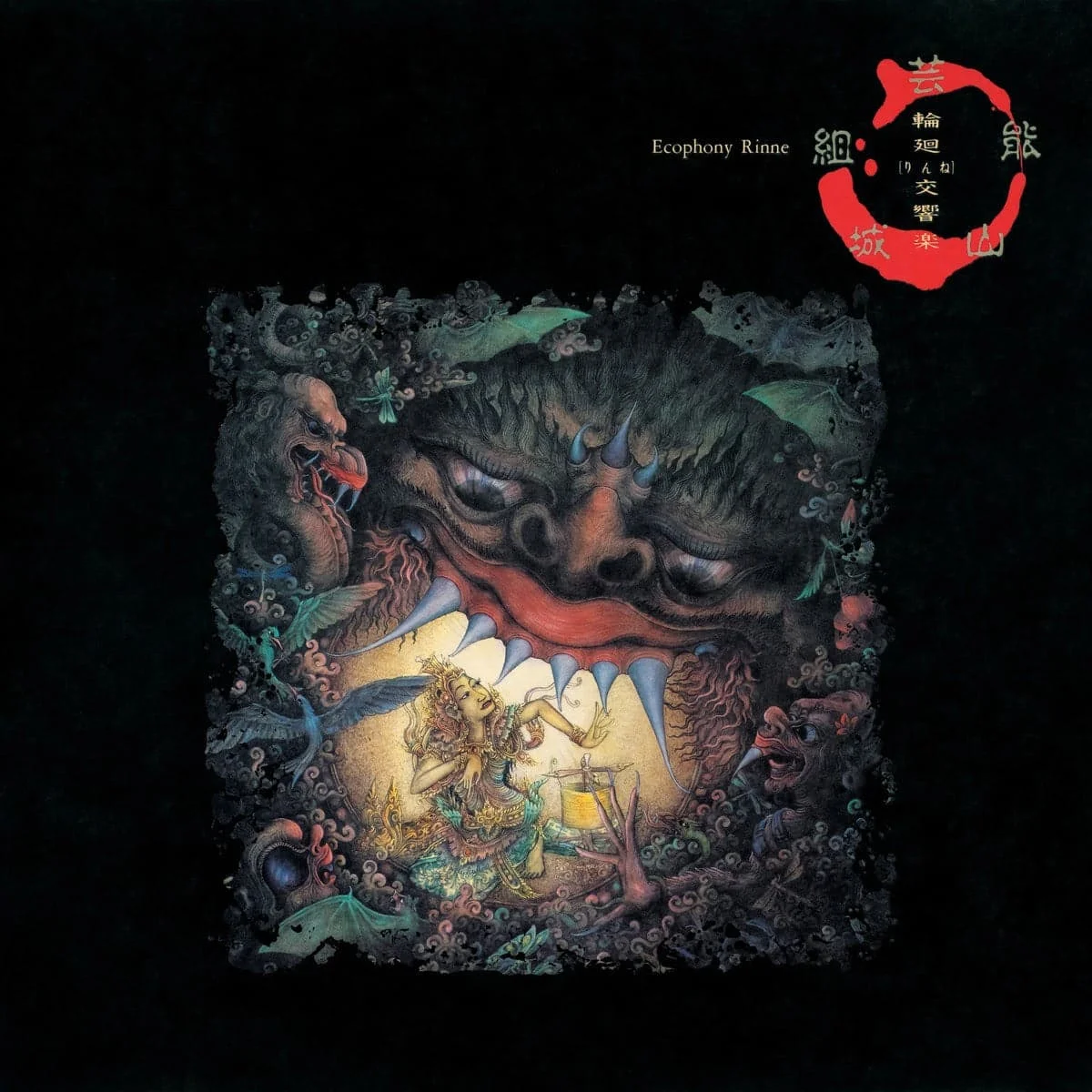
Ohashi later published research in the Journal of Neurophysiology demonstrating that ultrasonic frequencies above 20kHz, inaudible to human hearing, measurably affect brain activity when paired with audible sound. He called it the hypersonic effect. That research grew directly from the recording methodology on Ecophony Rinne and its successor Ecophony Gaia. The man was scoring the lifecycle of the universe and simultaneously running psychoacoustic experiments. I've written about the peculiarities of early Japanese CD mastering before. Ohashi's obsession with preserving ultrasonic content explains why his group's pressings demanded unusual care.
Two years after Ecophony Rinne, Katsuhiro Otomo commissioned the group to score Akira. He gave them only two conceptual themes, "festival" and "requiem," and let them compose before the animation was finished. The visuals were cut to the music, not the other way around. Everything that made the Akira soundtrack feel alien and inevitable, the jegog, the Noh chanting, the layered electronic processing, was rehearsed here first. Ecophony Rinne is the proof of concept that haunts the margins of one of the most celebrated soundtracks in film history.
Sources
-
Geinoh Yamashirogumi 'Ecophony Rinne' - Electronic Sound
-
The Music You Can't Hear - Time Capsule Sound
-
Ecophony Rinne Review - HHV Magazine
Filed under Music
This post is timestamped using Blockchain technology. Verify