Nowhere to Hide
Azzedine Alaïa showed his Fall/Winter 1989 collection in November, on his own schedule, inside a half-converted glass-roofed space in Le Marais that reportedly leaked when it rained. The official Paris Fashion Week calendar meant nothing to him. It hadn't since 1988, when he started presenting whenever the work was finished rather than whenever the industry demanded.
The timing was extraordinary. The Berlin Wall came down on November 9th that year. Mugler was sending models out in bodywork-bustiers shaped like 1950s Buicks. Montana had just been tapped for Lanvin couture. The decade's theatricality was reaching terminal velocity, everything louder, bigger, more conceptual.
Alaïa's response was a room full of black.
Not black as absence. Black as argument. He'd said that limiting his palette left nowhere to hide, that stripping away colour forced the purest expression of structure. The collection delivered on that premise with sculptural precision that made everything else feel like costume. Cropped jackets in black lamb suede. Thick velvet knit nearly an inch deep. Varnished leather with cutout guipure lace motifs. Each piece engineered so that the seams and zips weren't just functional but structural, spiralling around the body in ways that simultaneously revealed and supported it.
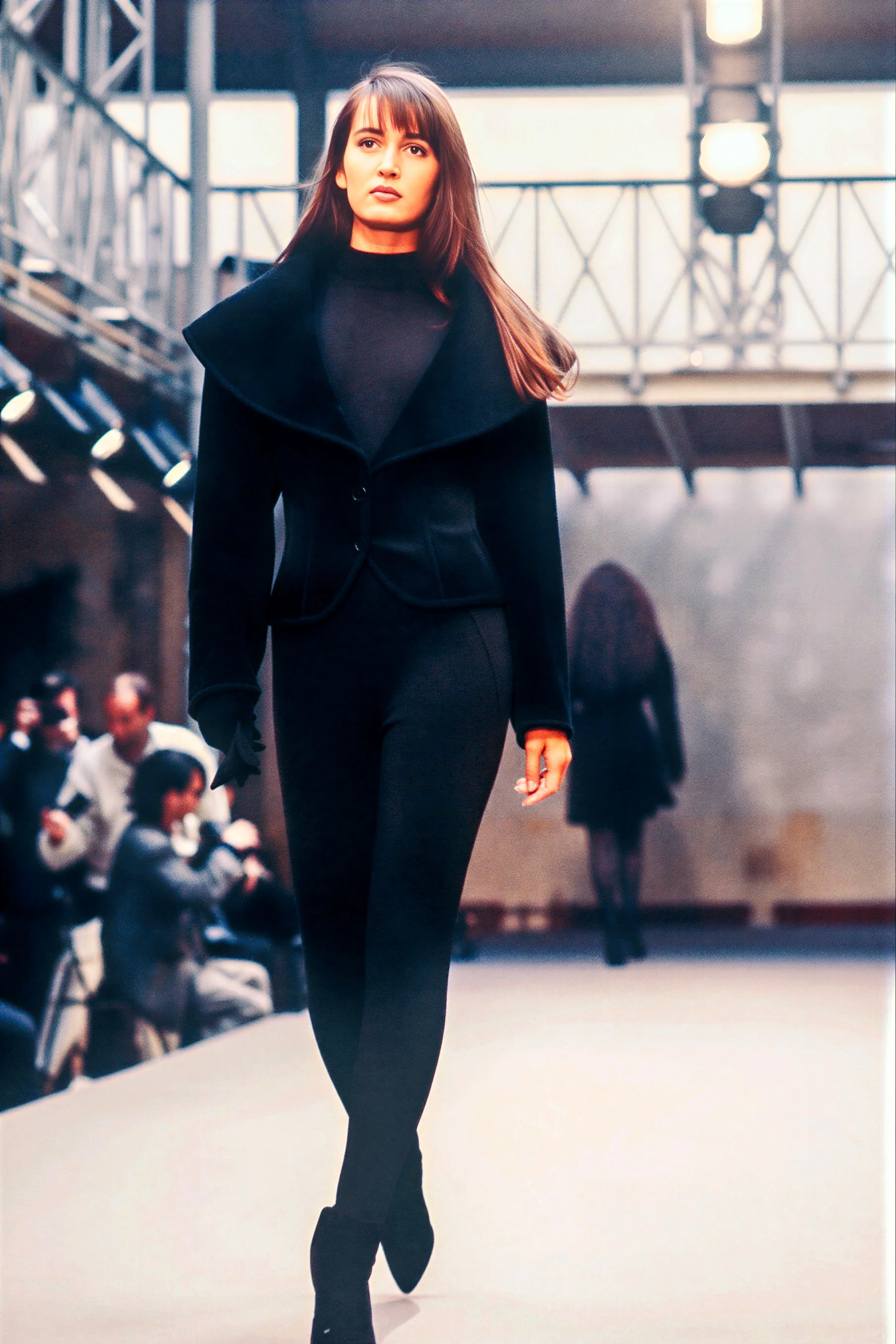
Naomi Campbell walked. So did Yasmin Le Bon, Elle Macpherson, Nadège du Bospertus. They came because they wanted to, not because of fees. Campbell had known Alaïa since she was sixteen and called him papa. The relationships were real, which made the shows feel different from everything else happening in Paris that season.
He'd trained as a sculptor in Tunis before he ever touched fabric, and it showed in ways the King of Cling nickname never captured. The body-consciousness wasn't about sex appeal, or not only. It was about treating a garment as a three-dimensional object with its own internal logic. Every bandage strip cut to a specific width. Every seam placed to map the body underneath rather than impose a silhouette over it.
Thirty-seven years on, most of what hit the Paris runways in November 1989 looks dated. The Mugler Buick collection has become a curiosity. Montana's Lanvin tenure is a footnote. Alaïa's black suede jacket still looks like something you'd want to wear tomorrow.
Filed under Azzedine Alaïa
This post is timestamped using Blockchain technology. Verify