Forty Years of Moths and Silence
Talk Talk's third album turned forty this month, and the fact that it still sounds like nothing else is probably the only review it needs. The Colour of Spring arrived in February 1986 at the precise moment when the band's label expected another synth-pop record and Mark Hollis had already decided he was done making those.
The first two Talk Talk albums were decent — The Party's Over and It's My Life had singles that charted, videos that rotated on MTV, and enough commercial momentum to keep EMI comfortable. But something shifted between 1984 and 1986. Hollis brought in Tim Friese-Greene as co-producer and collaborator, and between them they dismantled the template. The synthesisers didn't disappear entirely, but they receded. In their place: real strings, a harmonica that sounds like it wandered in from a field recording, Steve Winwood playing organ on "Life's What You Make It," and a general sense that the band had stopped caring about radio formats altogether.
They hadn't, of course. "Life's What You Make It" went to number sixteen in the UK, and "Living in Another World" charted too. The album sold over two million copies. What's strange is that none of those commercial facts prepare you for what the record actually sounds like. The singles worked almost by accident — they had hooks buried inside arrangements that were far more spacious and unpredictable than anything on the charts at the time. "Happiness Is Easy" opens the album with children singing over what might be the warmest, most unhurried four minutes in the entire decade. There's no chorus. There's barely a structure. It just breathes.
That breathing is what separates The Colour of Spring from its contemporaries. Every other mid-eighties record was compressed and gated and slammed into the loudness ceiling of the era. This one has room. Lee Harris's drums sound like actual drums in an actual space, not like triggered samples bounced through a Lexicon reverb. Paul Webb's bass sits low and patient. And Hollis's voice — already one of the most distinctive instruments in British music — occupies the centre of the mix with a vulnerability that borders on discomfort. He sounds like someone who knows exactly what he wants to say and isn't entirely sure he should say it.
"I Don't Believe in You" is perhaps the finest single track on the album, though it was never released as one. Seven minutes of slow accumulation, strings entering at the halfway mark like a tide coming in, Hollis repeating the title phrase with increasing conviction until it becomes something closer to prayer than pop. The production decisions are meticulous without being clinical. Friese-Greene had a gift for knowing when to leave a take alone — when the imperfection was the point.
The sequencing matters. "April 5th" follows and strips everything back to acoustic guitar and voice, the quietest moment on the record and the one that most clearly points toward Spirit of Eden two years later. The transition from the orchestral swell of the previous track to this bare whisper is the most sophisticated editorial decision on the album. It's also the moment where you realise this isn't a collection of songs. It's a single sustained thought.
"Chameleon Day" remains underrated. There's a guitar tone in the second half — distorted but somehow gentle, like looking at sunlight through frosted glass — that I've never heard replicated on any other recording. I've tried to identify the signal chain. I can't. Some sounds belong to their moment and refuse to be reverse-engineered.
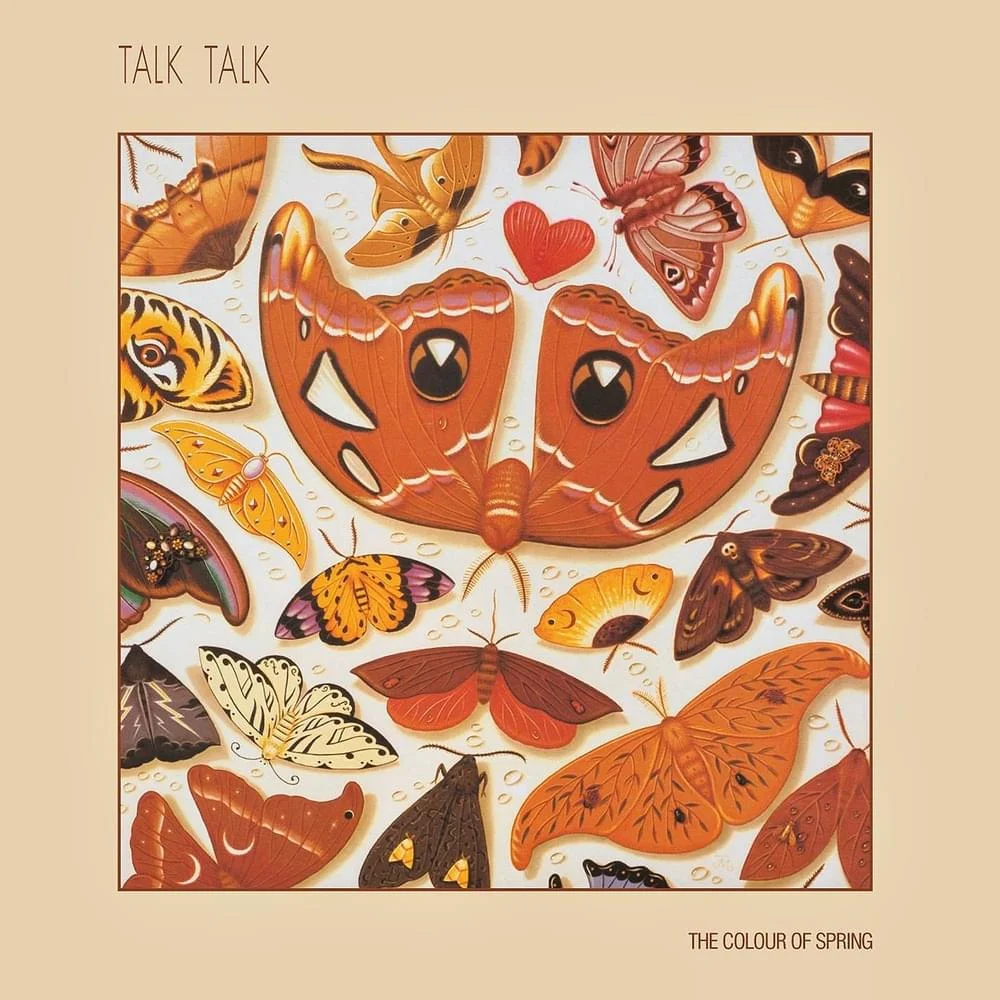
James Marsh's cover art deserves separate attention. The atlas moths and butterflies arranged around that central symmetrical face have become one of the most recognisable sleeves in the catalogue of British music. Marsh painted every specimen individually, working from real entomological references. The warm ochre border, the careful taxonomy of wing patterns — it's not psychedelic, not surrealist, not anything easily categorised. It sits on the shelf and draws the eye forty years later with the same quiet insistence as the music inside.
What happened next is well documented. EMI expected The Colour of Spring II and instead received Spirit of Eden, a record so uncommercial that it triggered a lawsuit. Hollis had used the goodwill and budget earned by two million sales to make precisely the album he wanted, which turned out to be a work of near-silent impressionism that had more in common with Morton Feldman than Duran Duran. The label was furious. The critics were confused. History has been kinder.
But The Colour of Spring is the hinge. Without it, the later records don't exist — Hollis needed this album's commercial success to buy the creative freedom that produced Spirit of Eden and Laughing Stock. And without the later records, The Colour of Spring might have been remembered as merely a very good album from 1986 rather than the first chapter of one of the most remarkable trajectories in recorded music. Each record retroactively elevates the others.
Forty years. Mark Hollis died in February 2019, almost exactly thirty-three years after this record's release. He spent the last two decades of his life in near-total silence, having said everything he needed to say in approximately twelve hours of recorded music. The restraint of that — the refusal to tour, to reissue, to capitalise — might be the most Talk Talk gesture of all.
Filed under Music
This post is timestamped using Blockchain technology. Verify