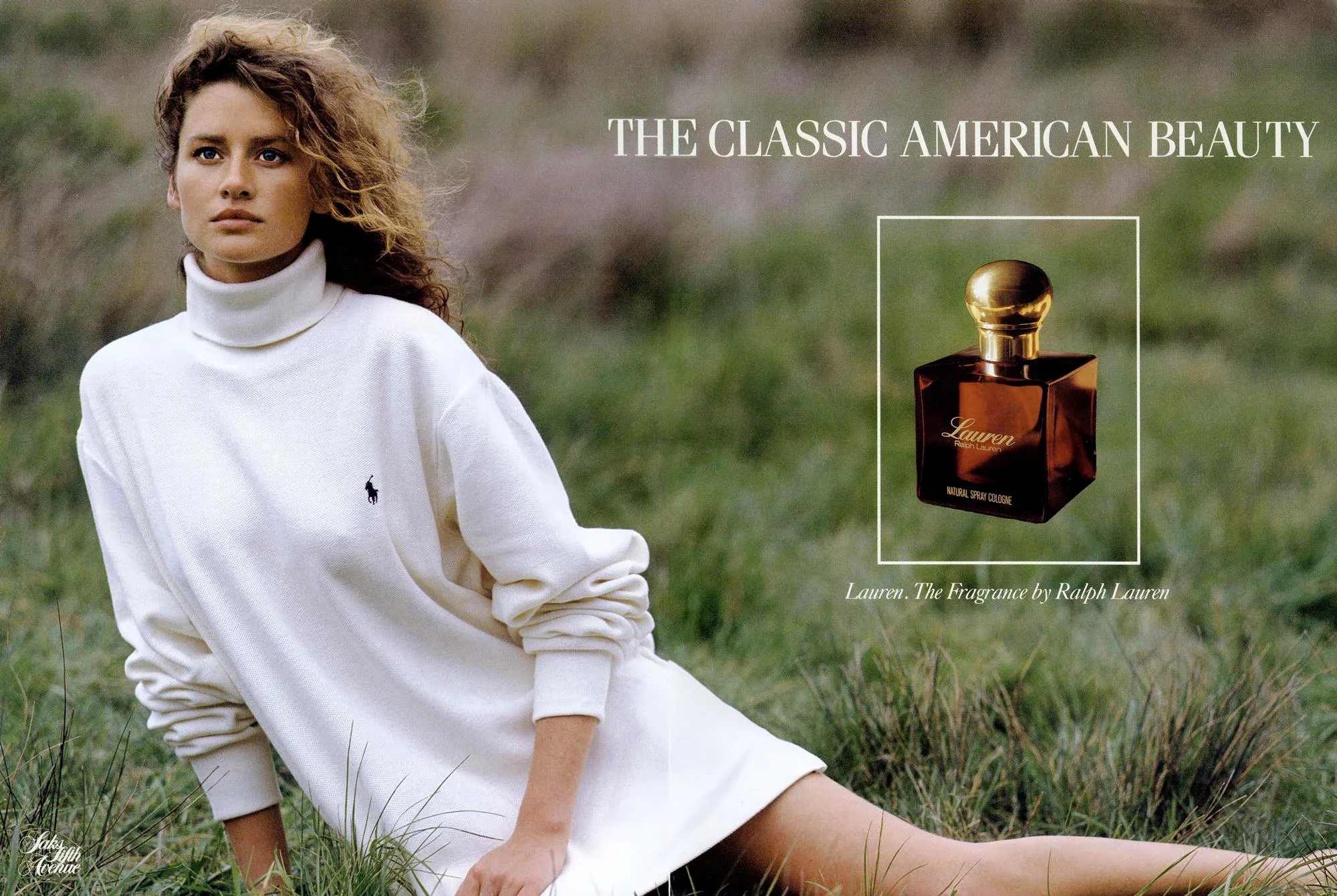
The headline does the whole job before you reach the bottle. “The Classic
American Beauty,” it says, across a field of tall grass, and there she is in a white turtleneck, hair loose, no jewellery, no city in sight. The perfume
sits small in the upper corner, almost an afterthought, a squat amber flask
with a brass cap. Ralph Lauren had already learned the trick that made him
rich. You don’t sell the thing. You sell the world the thing lives in, and
let people buy their way toward it one bottle at a time.
The bottle was Lauren, his first fragrance for women, and by the time this
ad ran in 1990 it was already twelve years old.
Lauren launched in 1978 alongside Polo for men,
and the simultaneous release was itself a piece of strategy nobody had tried
before. No designer had sent a men’s and a women’s scent into the world on
the same day. Lauren talks about it now as if it were obvious, that his
world held both, so the fragrances should arrive together. At the time it
was a gamble dressed as common sense.
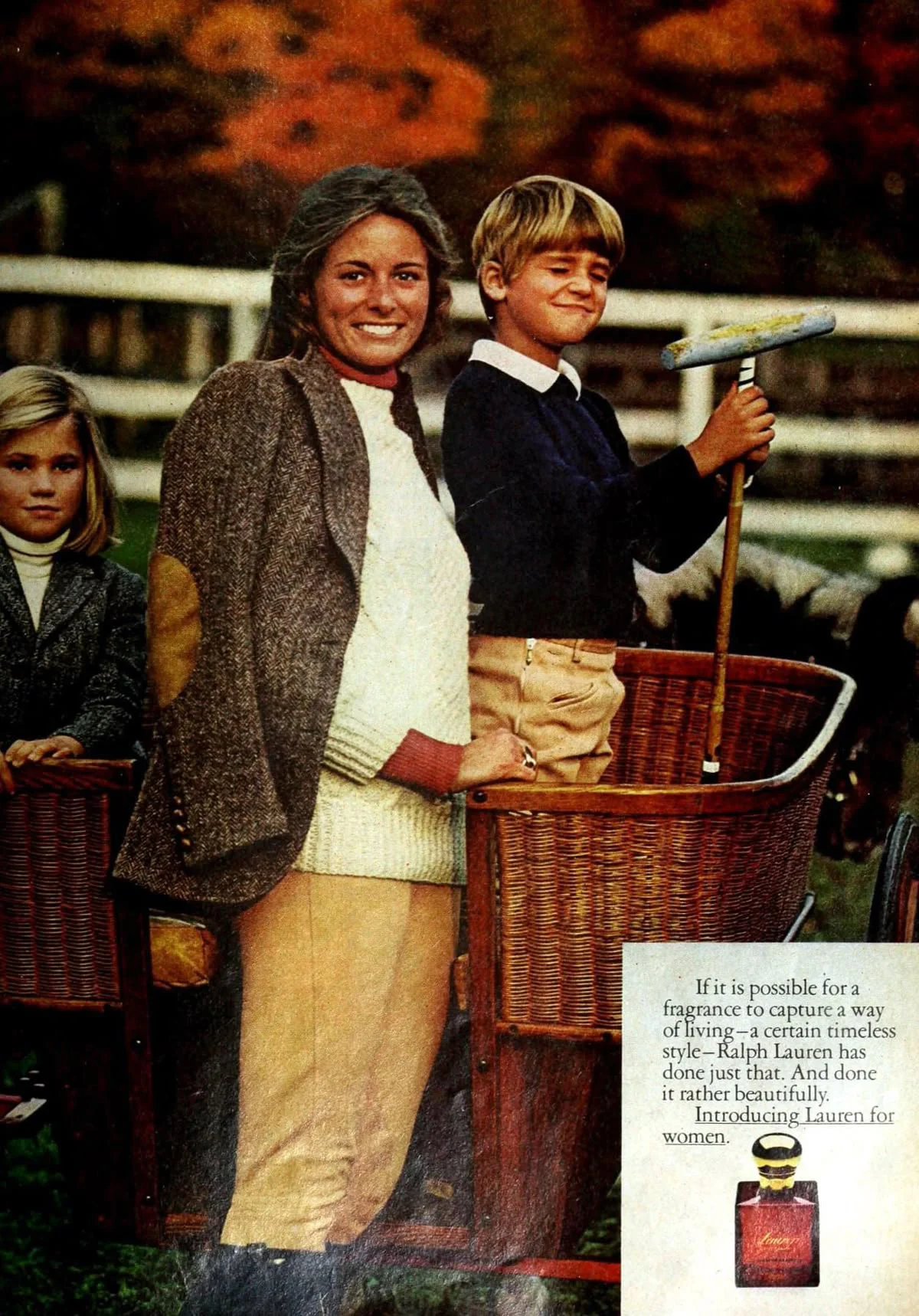
The original pitch made no attempt to describe a smell. The 1978 launch advertisement set a woman and two children beside a horse-drawn carriage
in autumn light, a polo mallet in a boy’s hand, and promised only that a
fragrance could “capture a way of living, a certain timeless style.”
Introducing Lauren for women, the copy said, and the bottle sat in the
corner like a detail you might overlook. The strategy was already complete
twelve years before the turtleneck and the field; all the 1990 version did
was swap the family for a single woman and make the country quieter.
So was the company he kept. He had been courted by Estée Lauder, the natural
home for a designer scent, and turned them down for Warner Communications,
the entertainment conglomerate that owned record labels and film studios.
The two formed Warner/Lauren Ltd, and a media company with no perfume
pedigree put out one of the most American fragrances ever made. The
juice came from Bernard Chant, the perfumer behind Aramis and Estée
Lauder’s Aliage and Azurée, a man who built scents like architecture. Chant
gave Lauren a green vegetal chypre, all rosewood and cedar and oakmoss, more
forest floor than flower shop. Ben Kotyuk designed the flask. The whole
thing was sold, with a straight face, as a “natural spray cologne,” and that
phrase tells you everything. Not perfume. Not parfum. Nothing French. A
cologne, natural, the way a sweater is natural, the way a walk is natural.
Nothing about the grass and the turtleneck was accidental either. The pitch
was wholesomeness, the open country, the woman who looks like she belongs to
a family with land. In the two-page spread that ran in American Vogue that
December, the fragrance barely registers and the woman is the entire
argument. Everything Lauren wanted you to feel about the scent, he makes you
feel about her instead.
The photograph hides a joke. The Classic American Beauty is Isabelle
Townsend, and Isabelle Townsend was born in Paris. Her father was Group
Captain Peter Townsend, the RAF officer whose
romance with Princess Margaret became the great royal scandal of the 1950s,
the equerry the palace could not let her marry. After Margaret, Townsend
married a young Belgian woman, Marie-Luce Jamagne, and Isabelle was their
daughter, raised speaking French and English, reading French and English
literature at the Sorbonne between 1979 and 1982. By the time Ralph Lauren
cast her as the face of his all-American dream, she had a British war hero
for a father, a Belgian mother, a Paris childhood, and a literature degree
from one of the oldest universities in Europe.
She signed an exclusive contract and became the brand’s defining face for
years. The American-flag sweater she wore down the runway in the autumn of
1989 turned into one of the house’s permanent images, the kind of thing that
gets reissued and reframed decades later. She worked with Bruce Weber and
Richard Avedon and Peter Lindbergh,
the same photographer who would soon argue that no single face could carry a
whole decade. The campaign worked precisely because the
Americanness was built rather than inherited. You assemble the myth out of
whatever materials photograph well, and a Sorbonne graduate in a turtleneck
photographs beautifully.
She was not the first import. An earlier Lauren advertisement puts Kristin Holby in a red Fair Isle
turtleneck, backlit against a blur of autumn gold, under the line “There are
fashions in fragrance. And then, there are certain fragrances beyond
fashion.” Holby was born in Oslo in 1951 and grew up in Larchmont, in
Westchester County. She modelled under her middle name, Clotilde, and by the
spring of 1976 she was walking every major show in Paris, starting with Yves
Saint Laurent. By her own account she became the first model to hold three
exclusive contracts whose campaigns ran at the same time: Saint Laurent for
Europe, Shiseido for Asia, Ralph Lauren for the Americas. She remembers the
decade that followed as the years America knew her as “The Face” of Ralph
Lauren. She retired in 1988, and when she opened a dress shop in Larchmont
in 2007, her old Lauren perfume ads hung on its walls. So two of the women
who sold this American field were a Norwegian and a Parisian, and both ended
up in the movies. Holby played Penelope Witherspoon, Dan Aykroyd’s fiancée,
in Trading Places.
The fragrance had a quieter, sadder ending than the woman who advertised it.
Through the 1990s the licensing passed to Cosmair, then to L’Oréal, and the
formula got reworked more than once. Each version sanded a little more off
the original, the oakmoss thinning, the strange earthy bitterness softening
toward something safer. By the end of the decade Lauren was discontinued.
Collectors now pay frightening prices for the early Warner/Lauren bottles,
the ones that still smell the way Chant intended, while the thinned-out late
versions ran down to clearance shelves on their way out of production.
What replaced it tells you how the whole industry changed. In 1998 Ralph
Lauren launched Romance, and Romance took over as the flagship women’s scent
almost overnight. Where Lauren had been green and woody and a little severe,
Romance was a soft rosy floral built for a younger buyer, the sort of scent
that sells by the truckload at a department-store counter. The austere green
chypre belonged to the 1970s; the warm floral was made to be liked, and
liked sells. The brand survived the swap without a scratch, because the brand
was never really about the smell. It was about the field, the turtleneck, the
woman who looked like she had somewhere green to go.
Lauren the perfume is gone, reformulated into a memory and then out of
production entirely. Isabelle Townsend left modelling for acting and the
stage, turned up in a Whit Stillman film and a few theatre productions, and
mostly stepped out of the picture she had defined. The picture outlasted them
both, and it still works on whoever turns the page, which is the strange
mechanics of a manufactured image: the more of it you can prove was invented,
the better it does its job.