Giorgio Armani spent the spring of 1989 selling almost nothing. The
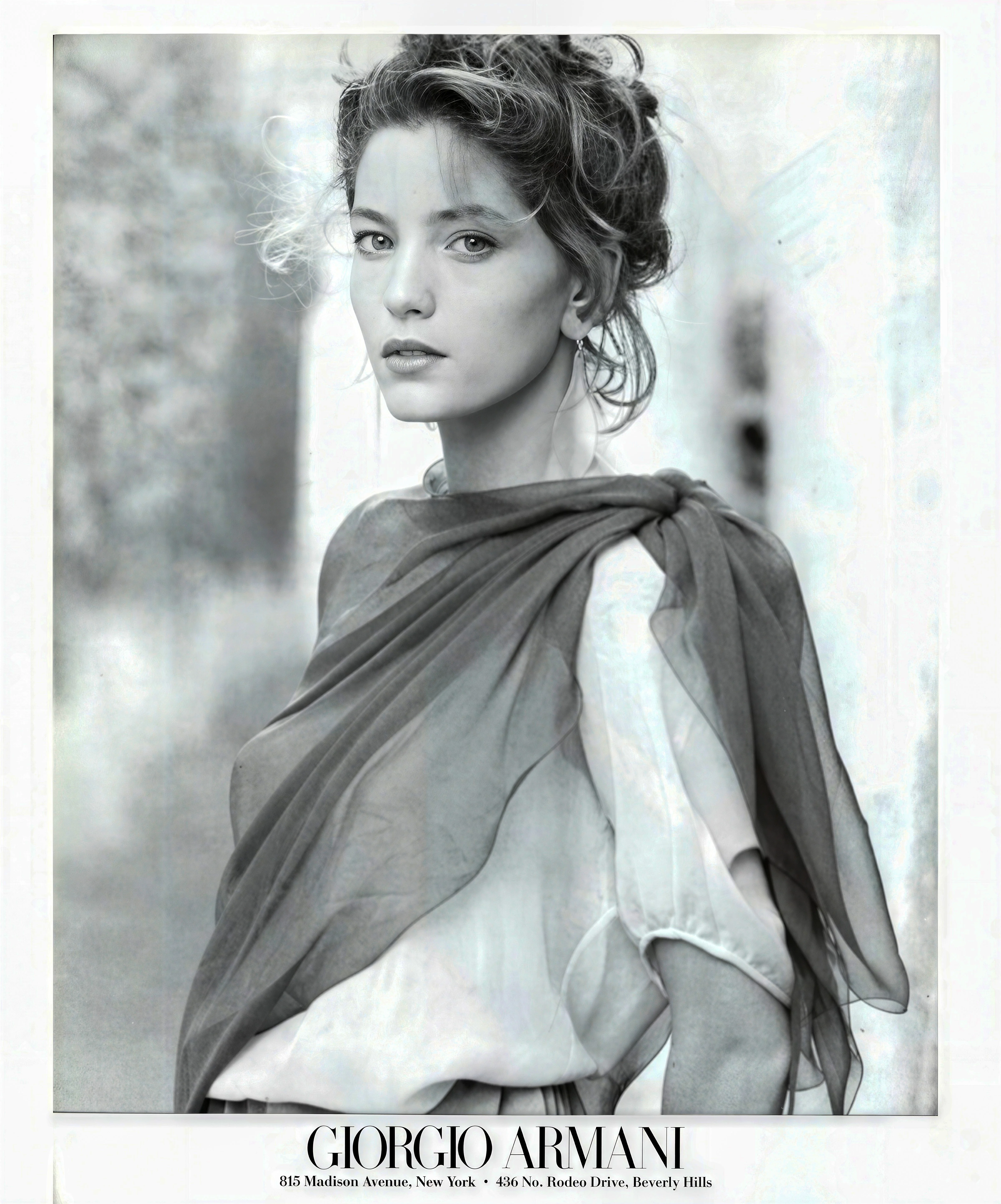
women’s campaign that ran that season, photographed by Aldo Fallai, has
no location, no props, no story to stage. A young woman stands against a
blown-out pale ground, a length of grey chiffon draped and knotted over
one shoulder, her hair pinned up and coming loose at the edges. Black
and white, printed under the plain capitals of the house name and two
store addresses, Madison Avenue and Rodeo Drive. That is the entire
advertisement, and it was one of the most self-assured things a fashion
house was putting in magazines at the time.
Fallai had been Armani’s eyes since the mid-1970s, when the two met in
Milan and worked out a way of photographing clothes that treated them as
evidence of a life rather than objects on a rail. He shot in black and
white on purpose, calling it a way of “allowing a narrative abstraction,
where telling the story is more important” than any faithful record of a
fabric. Stripped of colour, a garment stops being a swatch you could
match in a shop and becomes atmosphere, something the woman is standing
inside rather than wearing. His pictures are portraits before they are
advertisements, built around the character and the small imperfections
of the person in the clothes, and he kept away from the trendy famous
faces that would have pulled attention onto themselves. That instinct is
most of the reason these campaigns still hold up.
By 1989 Armani had nothing left to prove. American Gigolo had put Richard
Gere in his soft, unstructured tailoring back in 1980 and taught a
generation of men what a jacket could feel like without a rigid shoulder
holding it up; two years later he was on the cover of Time, only the
second fashion designer to get there after Christian Dior. The women’s
wear made the quieter version of the same case, trading the armored power
suit for fluid fabric and an easier line, dressing the woman who had just
reached the boardroom and had no need to shout about it. By the end of
the decade the whole Made in Italy phenomenon had a face, and most of the
time it was his.
Which is what makes the casting here worth sitting with. The model is
Lucie de la Falaise, and in 1989 that name meant almost nothing to the
public. In the picture she stands half-turned, hair loosely up,
chiffon knotted at one shoulder
and falling loose across a pale blouse, looking back at the lens with a
composure that reads much older than the fifteen or sixteen she actually
was. What she had instead of fame was lineage. Her grandmother, Maxime de
la Falaise, had modelled Schiaparelli in the 1950s and been called by
Cecil Beaton the only truly chic Englishwoman. Her aunt was Loulou de la
Falaise, Yves Saint Laurent’s muse for the better part of thirty years.
Lucie herself had grown up on a Welsh sheep farm without a television,
and been discovered when André Leon Talley came to profile the family and
could not stop looking at her.
That is exactly the face Fallai and Armani reached for: not a monument,
not a supermodel hardening into her own logo, but someone with particular
features and an air of inherited ease, taste worn so lightly it looked
like an accident of birth. Calvin Klein was following the same instinct
across the Atlantic that year,
reaching past the era’s monuments
for a face that would not pull focus off the mood. The chiffon does the
work the girl does. It reads as luxury without naming a price, and the
drape was house vocabulary by then; a year earlier Armani had sent
nearly the same idea down the runway,
silk falling across the body like something half-borrowed from antiquity.
The timing is the sharpest part. This campaign came before Saint Laurent
claimed her. She walked her first YSL couture show in January 1990,
closed it in a pink bridal gown, and spent the next four years as the
house’s bride and the face of its Paris perfume; by 1992 a Steven Meisel
shoot and a pixie cut had renamed her the gamine of the moment and folded
her into the waif wave Kate Moss was about to lead. Armani got her while
she was still a well-bred teenager doing European fashion work, and that
stretch sits oddly outside her official story, which prefers to begin at
the Saint Laurent runway.
None of this looked radical in 1989, which was the point. The Armani
advertising had become its own institution by then, a black-and-white
register so consistent across billboards and magazine pages that you
could name it before you read the logo. What looks unusual now is how
little the pictures have dated, and the house has leaned into that. In
2023 it gave the whole partnership a retrospective, Aldo Fallai per
Giorgio Armani, 1977 to 2021, roughly 250 images hung across two floors
of the Armani/Silos in Milan without a caption in sight. Armani said he
was struck by the power the shots still emanate. Two years later the
International Center of Photography handed Fallai a special recognition
award for work most people had only ever read as advertising.
Lucie is somewhere in those 250 frames, still a teenager and entirely
unbothered, a scarf knotted at her shoulder, looking as though the whole
apparatus of Milan had been arranged for her convenience. A year later
the fame she had no part in asking for arrived, and it never quite
remembered where it found her.